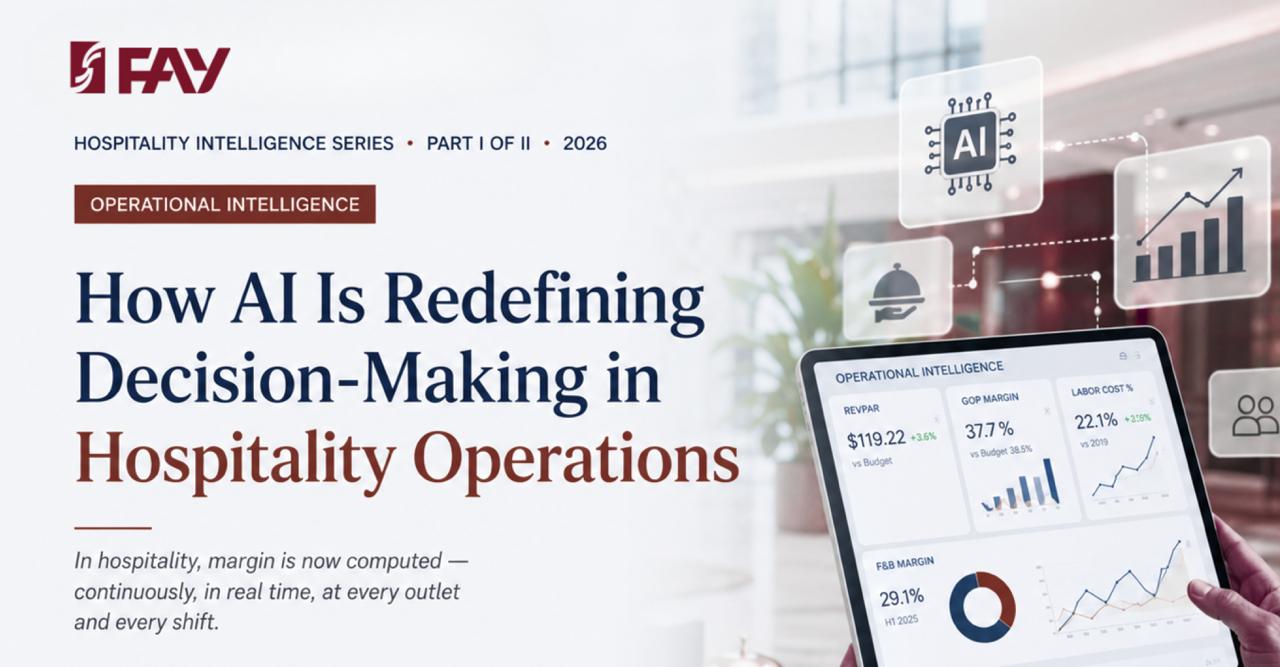
In hospitality, margin is now computed, continuously, in real time, at every outlet and every shift.
EXECUTIVE SUMMARY The hospitality industry is collecting more data than at any point in its history, and leaving most of it unread. The gap between data collected and data acted upon is a decision-making problem, one that costs operators margin every single day. Applied correctly at the property level, AI transforms the operating model: shifting from a structure that reacts to what already happened, toward one that anticipates what is about to happen and prescribes exactly what to do. For investors, the implication is direct. AI-enabled assets are entering a different performance category. The competitive gap in hospitality is decision speed, and the operators who close it first are building an advantage that widens with every passing quarter. |
The Decision-Making Problem
Hotel operations have historically run on instinct, hierarchy, and lagging information. The GM reviews yesterday’s numbers over morning coffee. The F&B director looks at last week’s covers to staff this weekend. The revenue manager adjusts pricing based on last month’s occupancy and a competitor check already four hours old. The result is a management structure shaped for a simpler era, one the volume and velocity of modern hotel data has long since outgrown.
The financial cost of this structure is measurable and accelerating. According to CBRE Hotels Research, hotel profit margins at both the GOP and EBITDA level declined in 2023 and 2024, with expenses outpacing revenue growth, a trend CBRE’s February 2025 Hotel Horizons forecast projects to continue. Operators entered 2025 budgeting RevPAR of $131.37 for the first nine months; actual results came in at $119.22. Budgeted GOP margin: 38.5%. Actual: 37.7%. The gap between expectation and outcome is an operational story.
Labor is where the pressure concentrates. According to HotelData.com’s 2025 Hotel Labor Costs and Trends Report, drawn from approximately 5,000 U.S. hotels, operators are paying 22.1% more than in 2019 for 7.4% fewer hours worked. Labor represents 47 to 60% of total operating expenses, per Cloudbeds’ 2026 Independent Hotels Report. F&B labor costs alone grew nearly 15% in 2024, outpacing every other department (STR). In an environment where RevPAR growth is measured in fractions, a 15% labor cost surge in a single department demands a precision that rate strategy alone cannot deliver. It requires intelligence, applied in real time.
The h2c 2025 global study found that 78% of hotel chains already deploy AI systems, with 89% planning expansion. Yet only 7% operate with a comprehensive AI strategy. Adoption has arrived. Transformation has lagged. Technology deployed within an unchanged decision-making framework produces dashboards. The industry has a decision-velocity problem, and the data to solve it already exists.
What AI Actually Does, and Where the Margin Lives
The applications that matter to operators and investors are the analytical and prescriptive systems that process operational data in real time and convert it into specific, actionable recommendations. Three distinct tiers of capability define where a property actually stands, and most hotels remain in Tier 1.
Tier | Capability | What It Does | Where Value Is Created |
|---|---|---|---|
Tier 1, Descriptive | What happened? | Dashboards, reports, historical performance summaries | Visibility, replaces manual reporting |
Tier 2, Predictive | What will happen? | Demand forecasting, staffing models, pricing projections | Planning, reduces misallocation of labor and inventory |
Tier 3, Prescriptive | What should I do? | Real-time recommendations: menu repricing, yield decisions, upsell triggers, labor redeployment | Margin, where operational decisions directly change outcomes |
Source: FAY Investment Group framework. Standard AI capability classification applied to hospitality operations.
Tier 3 is where the return lives. McKinsey’s State of AI 2025, drawn from 1,993 participants across 105 nations, found that high-performing AI organizations are nearly three times as likely to have fundamentally redesigned workflows around intelligence, going well beyond simply layering AI tools onto existing processes. IBM research shows companies realizing an average return of $3.50 for every $1.00 invested in AI when deployment is integrated into operational decision flows. The investment case is established. The execution risk is organizational, and it is the variable that separates AI leaders from AI adopters.
Where AI Creates Measurable Margin Improvement
The financial case for AI in hospitality operations is documented across four highest-impact application areas. Each one addresses a structural margin leak that weekly-cycle management leaves open.
Area | The Gap Without AI | What AI Enables | Documented Impact |
|---|---|---|---|
F&B Intelligence | Item performance reviewed weekly; cost variances identified after the fact | Real-time item analytics: cover trends, cost-per-item, pricing optimization, waste reduction | F&B department margins reached 29.1% in H1 2025 (CBRE, 2,669 properties). AI-driven operations demonstrate consistent outperformance of this baseline |
Labor Optimization | Static schedules misaligned with actual demand; surplus staffing at low-demand periods | Predictive staffing models aligned to real-time demand forecasts; dynamic shift deployment | Hotels using labor optimization cut hours per occupied room 7–15% while protecting GOP margins (HotelData.com, 2025, ~5,000 hotels) |
Revenue Management | Pricing decisions driven by lagging competitor data and historical patterns | Real-time dynamic pricing informed by booking pace, local events, and competitor movements | Marriott AI revenue management: 8–10% RevPAR increase. Hilton AI-driven segmentation: 5–8% revenue growth (company-reported) |
Ancillary & Direct Booking | OTA dependency erodes net margin; package pricing set on seasonal rather than demand logic | AI-driven bundle triggers, pre-arrival upsell targeting, channel mix optimization | Every 10-point channel shift from OTA to direct adds 2–4 percentage points to net revenue margin |
Sources: CBRE Hotels Research H1 2025; Actabl/HotelData.com 2025 Hotel Labor Report; Marriott International, Hilton Worldwide company-reported outcomes.
The F&B dimension deserves particular emphasis for integrated resort operators. CBRE’s analysis of 2,669 U.S. properties found F&B labor constitutes 59.4% of total F&B expenses, the single largest and most variable cost category in the department. An operator aligning F&B staffing to real-time cover projections, reviewing margin-by-item daily, and adjusting pricing and menu decisions accordingly is running a structurally different F&B business than one operating on weekly cycles. That structural difference flows directly into NOI, and from NOI into asset value.
The Compounding Moat, and the Window for Late Movers
AI adoption in hospitality produces asymmetric competitive outcomes. Most technology investments in this industry give early adopters a brief performance edge before the technology commoditizes and becomes equally accessible to all. AI operates on a different logic, because the value resides in the data the technology accumulates, and that data is proprietary.
Proprietary operational data, item-level F&B performance, guest preference patterns, demand signals specific to a property’s market and seasonality, and labor productivity benchmarks calibrated to a specific operating model, accumulates only through operation. An operator who has been building a data foundation for two years holds a structural lead that a competitor installing the same commercial platform today will find difficult to close, regardless of platform sophistication. The moat is what the system has learned. And learning takes time.
AI high performers are nearly three times as likely to have redesigned workflows around intelligence, building it into how decisions are made, rather than adding it alongside how decisions were always made.
There is a contrarian dimension here that the industry has been slow to absorb. Branded hotel properties operate within the brand’s technology ecosystem, reservation platforms, CRM systems, and reporting structures, engineered for portfolio-wide consistency rather than individual asset optimization. An independent owner-operator has full latitude to configure a technology stack calibrated precisely to the asset: its operating model, its guest profile, its competitive market, and its seasonal demand structure. The branded property’s standardization delivers predictability across a portfolio. The independent operator’s bespoke intelligence delivers margin precision at the asset level. These are meaningfully different competitive positions, and the gap between them widens as the data compounds.
The Cloudbeds 2026 Independent Hotels Report, compiled from 90 million bookings across 180 countries, found that the lodging market has split along a K-shaped trajectory: ultra-luxury RevPAR grew 10.6% in 2025, while economy segments experienced 18 consecutive months of decline. That performance divergence is driven by operational sophistication as much as market positioning. The assets generating superior returns operate with greater precision, deploy capital more efficiently, and respond to market signals with a speed that AI enables and manual management structures structurally cannot match. The operators who build this capability now, before the window closes, are setting the benchmark that others will be measured against.
Conclusion: The Operator Who Sees Everything Wins
The transformation in hospitality operations is a decision-making story, grounded in technology but realized through leadership. The technology exists, it is accessible, and it works. What determines which operators capture the value is the organizational commitment to rebuild decision processes around real-time intelligence, treating it as infrastructure rather than an experiment.
AI augments hospitality judgment rather than replacing it. A manager who understands guests, reads a market, and brings years of operational instinct to a property becomes more effective when those instincts are informed by real-time data rather than lagging reports. The quality and speed of information improves. In margin-constrained operations, where a decision made on Monday reshapes the cost structure on Tuesday, that improvement becomes a structural advantage, one that compounds with every operating cycle.
The largest hospitality groups have validated this at scale. Marriott International’s AI-driven revenue management platform has delivered an 8–10% RevPAR increase across its portfolio. Hilton’s AI-powered segmentation and pricing systems have produced 5–8% revenue growth. Hyatt and IHG have deployed machine-learning-based demand forecasting that has materially reduced labor misallocation and improved outlet-level profitability. These are core operational infrastructure decisions, embedded into properties numbering in the thousands. The lesson is consistent across every one of them: operators who redesigned workflows around intelligence captured the return. Prescriptive, real-time systems moved the margin. Dashboards alone did not.
Independent operators face real barriers entering this space: cost, complexity, and platforms calibrated to portfolios far larger than a single asset. That is not a reason to wait. It is a reason to start small and start now. The imperative is not to match the enterprise deployment of a Marriott. It is to begin building operational intelligence around the data that already exists and allow that capability to compound over time.
At FAY Investment Group, we are still in the early stages of this adoption journey. We are not presenting ourselves as having solved AI in hospitality operations. What we do believe, however, is that the industry is moving in a clear direction, and that operators who begin building these capabilities today will be materially better positioned tomorrow.
For us, that belief moved from theory into operational practice at The Villa Roma Resort in Sullivan County, New York, our flagship repositioning project. Like many hospitality operators, we had no shortage of operational data across restaurant reporting, Excel sheets, POS exports, and performance summaries. The challenge was not collecting information. The challenge was converting it into something timely, understandable, and actionable for managers making day-to-day operational decisions.
To begin addressing that gap, we implemented a Business Intelligence add-on within our Oracle Symphony environment at Villa Roma, giving us access to deeper operational visibility across check totals, tips, item-level sales performance, voids, comps, server productivity, and broader outlet trends. But even with stronger reporting infrastructure in place, extracting meaningful insights quickly enough to influence operations still required significant manual effort.
That realization led us to partner with an IT vendor to build a proprietary AI assistant called Angie, designed specifically around the operational needs of Villa Roma. Angie allows managers and directors to ask questions in plain language and receive immediate, structured insights about restaurant performance, demand patterns, and operational trends.
Even at this early stage, the operational value has been immediate. Managers can quickly understand what their day looks like, identify shifts in guest behavior, monitor outlet performance, and make faster operational decisions rather than waiting for weekly reviews. The platform has been especially useful in identifying top-selling items over time, surfacing underperforming menu items that may require removal or repricing, evaluating staff performance, and uncovering trends that previously would have remained buried inside reports until well after the opportunity to act had passed.
We also value the operational simplicity it creates. Reports can now be generated instantly and distributed directly through email, significantly reducing the gap between insight and execution. In parallel, we have utilized this same data infrastructure at Villa Roma to build a live sales dashboard, giving ownership continuous visibility into key operating metrics across the property.
The power of AI in hospitality is not replacement; it is amplification. It strengthens decision-making by giving operators access to faster, clearer, and more actionable intelligence. In an industry where margins are shaped by hundreds of small operational decisions every day, that speed and precision can become a meaningful competitive advantage over time.
What matters now is not perfection at scale, but the willingness to begin building the capability deliberately and consistently.
We are not claiming to have solved this. We are claiming to have started, and we believe that starting, even at a small scale, is the step that matters most.
For investors evaluating hospitality assets, AI operational maturity is becoming an underwriting variable with material implications. An asset getting smarter, accumulating data, sharpening its models, and deploying prescriptive intelligence across F&B, labor, revenue management, and ancillary yield is in a different performance category from an asset still running on weekly reviews and seasonal schedules. Over a five-year hold, that difference is real: in margin, in NOI, and in exit valuation.
The assets generating superior returns over the next decade will be those where operational intelligence is treated as infrastructure, built deliberately, compounded consistently, and protected as the proprietary asset it is. Every unread data point is a margin leak. Every delayed decision is an outcome already determined. The operators who close that gap first will find, in time, that the gap has become the moat.
COMING IN PART II OF THIS SERIES The operational case for AI is established. What remains underexamined is what AI capability does to the investment thesis for a hospitality asset, how it reshapes the risk profile, what it demands of due diligence, and why AI-enabled independent operators are positioned to structurally outperform brand-managed assets over the next cycle. That is the subject of Part II: AI as an Underwriting Variable, What Hospitality Investors Are Missing. |
Sandeep Wadhwa is Chairman of FAY Investment Group with over two decades of experience in hospitality and real estate investing. He has led multi-billion-dollar transactions and managed complex assets across global markets. His approach focuses on discipline, execution, and long-term value creation.


AI Hospitality Valuation: How AI Capability Is Reshaping Hotel Asset Value and Investor Returns
[…] CONTINUING FROM PART I […]