|
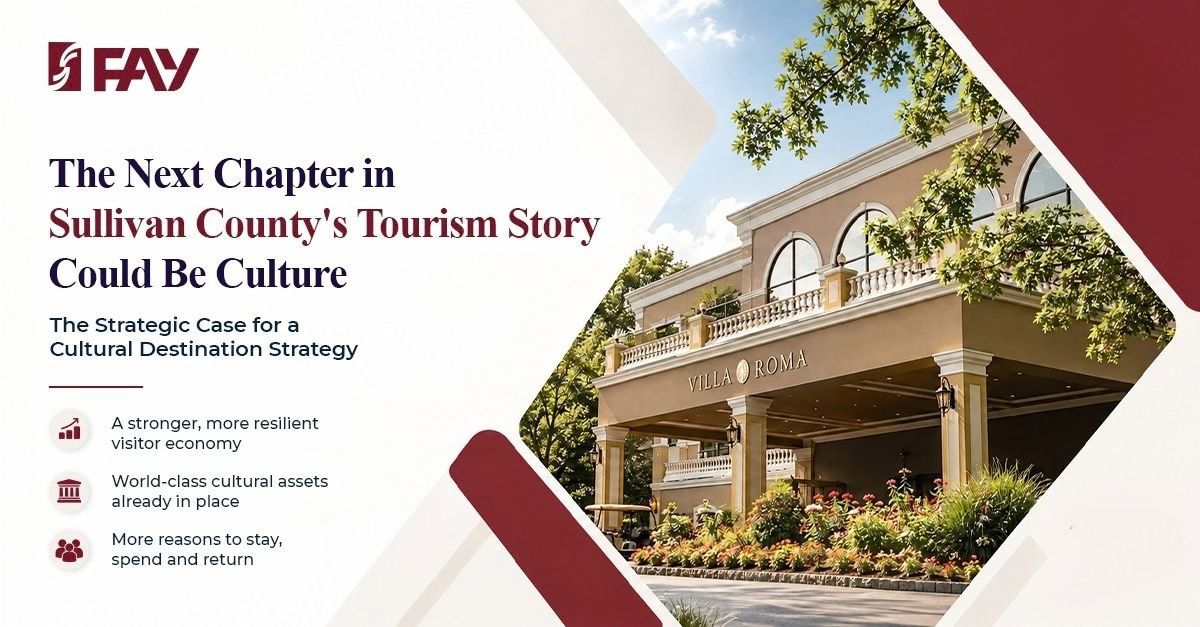
IN BRIEF Sullivan County’s visitor economy crossed 1 billion dollars in 2024. The next phase of growth depends less on attracting more visitors and more on giving them additional reasons to stay longer, spend more and return in different seasons. The county already has the cultural institutions to build that second driver. The opportunity is to connect them deliberately to its hospitality economy. |
Mature tourism economies grow by adding reasons to visit, layering new demand drivers on top of established ones so a single trip serves multiple purposes and a single season extends into several. Sullivan County crossed a meaningful threshold in 2024, and that milestone changes the strategic question the county should be asking next.
From Visitor Growth to Visitor Depth
Sullivan County’s visitor spending reached 1.03 billion dollars in 2024, up 6.4 percent from 968.9 million dollars in 2023, according to Tourism Economics data prepared for Empire State Development. Tourism now generates 17.2 percent of all personal income in the county and supports more than 5,000 jobs. This performance confirms a strategy built successfully around outdoor recreation, boutique hospitality and destination infrastructure, backed by real capital investment across the county.
|
Measure |
2023 |
2024 |
Change |
|
Visitor spending |
$968.9M |
$1.03B |
+6.4% |
|
Tourism jobs supported |
4,908 |
5,034 |
+2.6% |
|
Share of county personal income |
— |
17.2% |
— |
Source: Tourism Economics, prepared for Empire State Development, 2024 Catskills regional report.
Crossing a billion dollars in visitor spending changes the strategic question. The county has already demonstrated it can attract visitors at scale. The more valuable question now is how many reasons the county can give those visitors to stay an extra night, spend more while they are here, and return at different points in the year. Length of stay, frequency and seasonality are the metrics that define the next phase of growth, and they respond to a different lever than volume does. Outdoor recreation drew people to Sullivan County. A second, complementary demand driver is what extends the stay and the calendar.
Assets Already in Place
Sullivan County holds a cultural asset base that is more developed than its current tourism positioning reflects. Bethel Woods Center for the Arts operates on the site of the 1969 Woodstock festival, with a 16,000 capacity outdoor pavilion and a 422 seat indoor Event Gallery that runs programming across multiple seasons. The Forestburgh Playhouse, established in 1947, is the oldest continuously operating professional summer theater in New York State and enters its 80th anniversary season in 2026. Delaware Valley Opera has built a committed audience for opera and classical music in the county over a sustained period. The Delaware Valley Arts Alliance, Shadowland Stages and the Shandelee Music Festival extend that base further.
Given the scale of Bethel Woods, the opportunity is unlikely to be another large venue. The more interesting opportunity is a different kind of model, built around smaller, more intimate experiences where performance is woven into a complete stay rather than staged as a standalone event. That approach complements the county’s largest cultural institution instead of competing with it, and it opens space for opera, chamber music, dinner performances, artist conversations and cultural weekends that a 16,000 seat venue is not designed to deliver.
What This Could Look Like in Practice
A connected culture and hospitality model produces specific, plannable visitor behavior. A couple traveling from New York City for a Saturday evening performance arrives Friday, stays two nights, dines locally on both evenings, spends Saturday afternoon in the county, and attends the performance that night. A family attends a children’s program on a Saturday morning, joins a workshop in the afternoon, stays overnight, and combines the visit with recreation the next day. A group of six or eight books a three-day cultural weekend built around music, food and the outdoors. Each of these scenarios converts a single evening of programming into multiple nights of lodging and several meals, which is precisely the visitor profile a hospitality driven economy is built to serve.
The same logic applies across the calendar, not just across a single weekend. A summer outdoor performance, a fall cultural weekend, a holiday dinner and performance package, a winter chamber music series and spring family programming each serve a different visitor at a different time of year. No single one of these needs to be large. Together, they build calendar density, giving the county multiple points in the year where a cultural event is the reason for a trip rather than a single flagship week competing for attention with the summer recreation season.
The strategy also has a resident dimension that deserves equal weight. Family programming, school engagement, workshops, masterclasses and open rehearsals build a local audience alongside a visiting one. The visitor comes for the experience. The resident gives that experience permanence, sustaining attendance in the months when visitor volume is lower and building the kind of community support that allows a cultural program to last for decades rather than seasons.
The Evidence Behind the Strategy
National research supports this model in specific and useful ways. Americans for the Arts found that nonprofit arts and culture organizations and their audiences generated 151.7 billion dollars in economic activity nationally in 2022, supporting 2.6 million jobs. The more relevant finding for Sullivan County concerns visitor behavior. Attendees who traveled from outside the county spent an average of 60.57 dollars per person beyond the ticket price, more than double the 29.77 dollars spent by local attendees, and 77 percent of those non-local attendees said the cultural event itself was the primary purpose of their trip. That is a visitor who plans ahead, books a room and spends the evening in town, which is the exact customer profile the county’s hospitality sector depends on.
Two precedents confirm this model works in rural settings with no inherent cultural advantage over Sullivan County. The Glimmerglass Festival built a nationally regarded opera company in Cooperstown, a small village on Otsego Lake, beginning in 1975. The Chautauqua Institution, founded in 1874 on a lake in rural western New York, generates 233.1 million dollars in economic impact and supports 3,208 jobs in Chautauqua County alone, according to a 2023 study, drawing more than 100,000 visitors to a season built around performing arts and integrated lodging. Both destinations reached that scale through a sustained, deliberate strategy executed over decades, not through a single flagship launch.
Building Demand Before Infrastructure
The right sequence for Sullivan County starts with audience, not institution. The question worth asking first is not what venue or organization should be built. It is what audience can be built first, and what that audience’s behavior teaches about pricing, format and season. Productions carry real costs, audience development takes measurable time, and quality has to be established before scale is added. A credible strategy begins with a small number of well produced events, structured to test demand and economics before any larger commitment follows, with a fuller calendar and eventually a signature festival built as the outcome of successful seasons rather than the starting assumption.
A Question Worth Pursuing
Sullivan County already has the institutions, artists, venues and audiences that can form the foundation of a cultural identity. The opportunity is to connect those assets more deliberately with the county’s hospitality economy, and give visitors another reason to come, stay and return.
The next chapter in Sullivan County’s tourism story may therefore be less about creating another attraction and more about connecting the ones it already has.