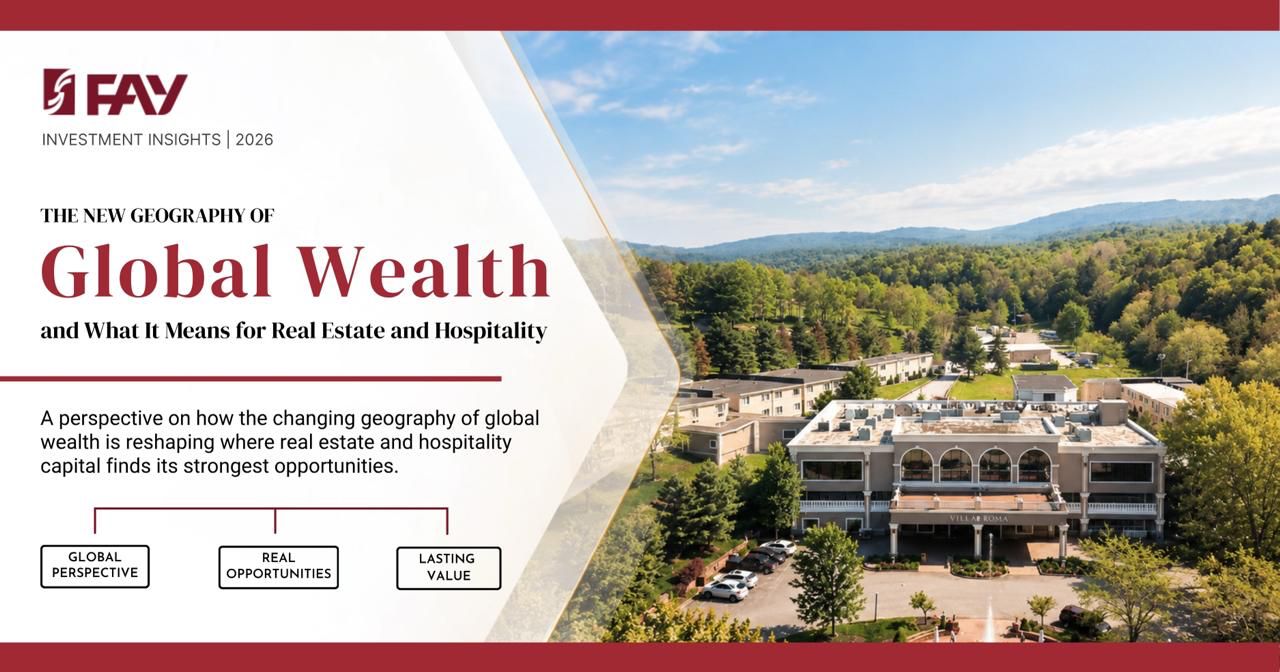
A perspective on how the changing geography of global wealth is reshaping where real estate and hospitality capital finds its strongest opportunities.
Global personal wealth grew 10.8 percent in 2025, the fastest pace of growth in eight years, according to the UBS Global Wealth Report 2026. The world’s population of ultra-high-net-worth individuals, those holding more than USD 30 million, rose from 551,435 in 2021 to 713,626 in 2026, an increase equivalent to 89 new UHNWIs every day, according to Knight Frank’s Wealth Report 2026. The pool of global wealth is expanding, and its geography is becoming more diverse.
That expansion is not the story that matters most to real estate and hospitality investors. The location of wealth and the location of demand are not the same thing, and capital does not have to follow wealth. It has to follow demand. Capital created in one market can increasingly be deployed across markets, allowing investors to compare opportunities on fundamentals rather than on geography alone. Understanding that distinction is now central to identifying where real estate and hospitality value will be created over the next decade.
The wealth map is changing
Wealth growth is no longer concentrated in the markets investors have historically watched most closely. Wealth in Europe, the Middle East and Africa rose 17.5 percent in dollar terms in 2025, more than double the 8.5 percent recorded across the Americas and nearly triple the 5.9 percent recorded in Asia Pacific, according to UBS. Currency movement explains part of that divergence, but the underlying pattern is durable.
The United States generated 41 percent of all new UHNWIs over the past five years, lifting its share of the global total from 33 to 35 percent, while India’s UHNWI population grew 63 percent over the same period and is forecast to expand a further 27 percent by 2031, according to Knight Frank’s Wealth Report 2026. Wealth creation is broadening geographically even as the United States remains its single largest source.
From wealth creation to capital deployment
More wealth does not automatically produce more real estate investment in the market where that wealth is created. Family offices illustrate the point. Deloitte estimates the number of single-family offices worldwide will grow from roughly 8,030 today to 10,720 by 2030, with the wealth these offices represent rising from USD 5.5 trillion to USD 9.5 trillion over the same period, according to Deloitte Private. That capital is mobile by design, built to move across currencies, jurisdictions and asset classes in pursuit of the strongest risk-adjusted return, not to stay anchored to its market of origin.
Real estate is a direct beneficiary of that mobility. Cross-border investment into United States commercial real estate rose 35 percent year over year in the first half of 2026 to USD 14.4 billion, while total United States commercial real estate investment volume climbed 21 percent to USD 250.3 billion over the same period, per CBRE. Capital is not simply larger. It is more willing to travel, and more selective about the fundamentals it will accept once it arrives. Once capital can move this freely, the origin of wealth stops being the determining variable in where it lands. What replaces it is demand, and specifically, which destinations can demonstrate a catchment of guests, spending and repeat visitation strong enough to justify the investment.
Hospitality turns location into an operating proposition
Hospitality is where that principle is tested most directly, because a hotel or resort’s value is not set by location alone. It combines a fixed physical asset with an operating business built on tourism demand, food and beverage, wellness, events and revenue management, so its return depends as much on how that business performs as on where the building sits. Global hotel transaction volumes rose 22 percent from the 2023 trough in 2025, with the JLL Global Hotel Investment Outlook forecasting a continued robust increase in 2026 on the back of strengthening debt markets and record capital availability.
Global wealth compounded at a 9.6 percent annual rate between 2015 and 2025, a pace JLL identifies as a direct driver of demand for luxury hotels and resorts. International tourist arrivals reached a record 1.52 billion in 2025, according to UN Tourism, confirming that the demand base underpinning hospitality returns keeps expanding even as wealth itself becomes more dispersed.
The geography of opportunity is changing
Gateway cities retain real advantages. Liquidity, international connectivity, institutional capital and economic concentration are not easily replicated, and nothing in the current data suggests investors are abandoning them. What is changing is the range of locations capable of competing for capital. Investors increasingly separate a property’s physical location from its economic catchment, the population it can realistically draw on for demand. A regional destination within reach of a major metropolitan area can access that city’s spending power without carrying its cost base, its competition for sites, or its compressed yields. That distinction, between where an asset sits and who it can reach, is becoming one of the more consequential variables in real estate underwriting.
For a resort investor, the relevant metric is not simply how many people live nearby. It is how many potential guests can realistically reach the destination, how frequently they are likely to visit, how long they stay, and how much of their total leisure spending the property can capture.
The rise of the drive-to leisure destination
Drive-to leisure benefits from proximity, repeat visitation and lower travel friction. These characteristics create a different demand profile from long-haul tourism, and they make short breaks economically meaningful for resort operators in a way a single annual trip cannot. A destination within two to three hours of a major metropolitan area can draw on that population’s income and travel frequency without needing to sit inside the metro area itself, supporting an operating business at a scale the destination’s own local population could not sustain alone.
The economics of proximity
Proximity changes the demand equation. A destination within a few hours of a major metropolitan area can draw from a consumer base far larger than its resident population. Shorter travel times also make weekend and repeat visits more practical, creating demand patterns that differ from destinations dependent primarily on long-haul or once-a-year tourism. For investors, the relevant market is therefore not simply the property’s postcode. It is the population, purchasing power and travel behaviour within its realistic drive-time catchment.
Sullivan County illustrates the shift
Sullivan County, in the western Catskills of New York State, sits within a few hours’ drive of the New York metropolitan area, placing it within reach of one of the largest metropolitan consumer markets in the United States. Visitor spending in the county reached USD 969 million in 2023, up 12.5 percent from 2022, according to data compiled by Tourism Economics for Empire State Development and I LOVE NEW YORK.
The significance of that figure is not simply its size. The same data show visitor spending supported an estimated USD 289 million in local employment income in the county in 2023, a scale that gives tourism a structural role in the county economy rather than a peripheral one, according to the same Tourism Economics data. For investors, the relevant question shifts from whether visitors come to Sullivan County to how effectively individual assets can capture and retain that spending.
The county’s demand base is diversified rather than dependent on any single asset. Bethel Woods Center for the Performing Arts, Resorts World Catskills, Monticello Raceway and the Upper Delaware Scenic and Recreational River each draw distinct visitor segments across different seasons, while a growing artisan food and beverage scene around Callicoon gives the region a culinary identity that hospitality operators can draw on directly. Sullivan County does not need to become a global gateway to attract capital. Its opportunity comes from its ability to connect a major metropolitan consumer base with a compelling leisure destination.
From hotel to destination
Drive-to leisure demand creates an opportunity for destinations, not merely accommodation. An integrated resort model that combines lodging with food and beverage, wellness, recreation, events and seasonal programming gives visitors more reasons to travel, stay longer and spend beyond the room rate. New York State recorded USD 94 billion in visitor spending in 2024, distributed across lodging, dining, recreation, retail and transportation rather than concentrated in accommodation, illustrating how broadly tourism spending is already spread across a visitor’s full itinerary. An integrated resort is built to capture a larger share of that itinerary within a single property rather than ceding it to the surrounding destination.
Legacy assets can create another form of value
Existing resort assets in drive-to markets often carry embedded value that current performance understates. Land, established infrastructure, access, brand recognition and decades of accumulated customer relationships are not easily replicated by new development, and they typically cannot be purchased separately from the operating business built around them. The same assets frequently carry real constraints: deferred capital expenditure, dated accommodation, underused recreational infrastructure and programming that has not kept pace with what today’s leisure guest is seeking. The investment case rests on the gap between an asset’s current performance and its underlying capability once that gap is addressed through disciplined capital investment and active management. That gap, not the acquisition price alone, is what determines whether a legacy asset represents value or simply a discount.
What investors should look for next
Five considerations follow from this shift. Economic catchment matters more than postcode, so investors should assess who can reach a destination and how much purchasing power exists within that radius, not only the population living inside it. Demand engine diversity matters, since destinations anchored by multiple attractions across different seasons carry less single-asset risk than those dependent on one draw. Revenue diversity matters, because an asset’s ability to capture spending beyond room revenue, through food and beverage, wellness and programming, increasingly determines its total return. Repositioning potential matters, since the difference between an asset’s current and achievable performance is often a larger source of value than the acquisition itself. Seasonality and resilience matter last, because a destination capable of generating demand across multiple seasons is structurally better positioned than one dependent on a single peak period, regardless of how strong that peak may be.
Where wealth meets demand
Global wealth is becoming more distributed, and the capital it funds has become correspondingly mobile. That mobility means capital does not have to follow wealth to its point of origin. It follows demand, and hospitality value depends on the strength of the catchment a destination can draw on rather than the prestige of its address. Drive-to destinations demonstrate how a property within reach of a major metropolitan population can access that population’s spending without needing to sit inside its boundaries, and Sullivan County demonstrates what that looks like in an actual market rather than a hypothetical one, a destination whose opportunity comes not from its own scale but from what it can reach.
FAY Investment Group evaluates hospitality and real estate assets through this same lens, assessing opportunity through the relationship between location, demand, asset potential and the ability to create value through active management rather than through the geography of wealth alone.
Gateway markets remain important, and nothing in current capital flows suggests that will change. What has changed is the range of destinations now capable of competing for capital, because investors increasingly follow demand catchment rather than wealth concentration in deciding where that capital lands.