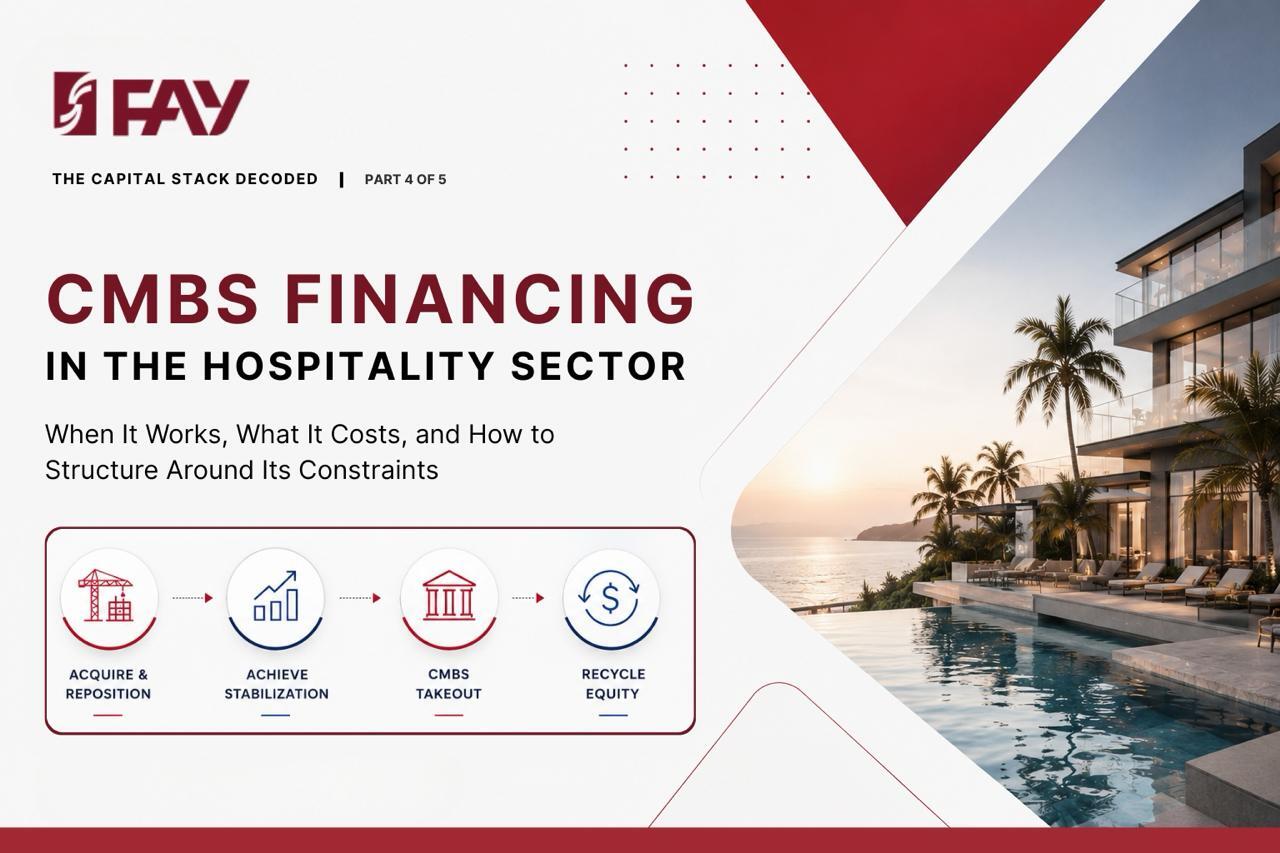
A precise account of how CMBS conduit financing works for hotel assets in 2026, what the underwriting thresholds actually are, where CMBS fits in a layered capital stack, and the structural constraints that make it the right permanent debt instrument for some hospitality transactions and the wrong one for others.
By Sandeep Wadhwa, Chairman, FAY Investment Group
1. The Permanent Debt Instrument That Rewards Stabilization
CMBS financing occupies a specific and well-defined position in the hotel capital markets. It is not a transitional instrument. It is not suited to a value-add acquisition, a brand conversion in progress, or an asset carrying below-stabilized occupancy. It is the permanent non-recourse fixed-rate debt instrument for stabilized hotel assets of institutional quality, and within that specific context it delivers terms that conventional bank financing and government-guaranteed programs cannot match: non-recourse lending, long-term fixed rates, and loan sizes with no practical upper ceiling.
The misconception that limits CMBS adoption in the mid-market hospitality segment is that investors treat it as interchangeable with conventional bank financing. The two instruments have different underwriting frameworks, different binding constraints, and different structural consequences for the borrower. A hospitality investor who understands CMBS specifically can position an asset for CMBS takeout from the moment of acquisition, use bridge financing or SBA 7(a) for the transitional period, and refinance into CMBS at stabilization with a materially improved capital structure. An investor who treats CMBS as just another loan product will be surprised by the debt yield gate and the prepayment structure.
CMBS issuance reached USD 125.6 billion in 2025, the highest level since 2007, according to Trepp. The conduit market is active, competitive, and well-capitalized. The barrier to CMBS access for hotel assets is not market availability. It is asset stabilization and underwriting preparation.
2. How CMBS Underwriting Actually Works for Hotels
Hotel CMBS underwriting operates through a three-test framework: debt service coverage ratio, loan-to-value, and debt yield. All three must clear the lender’s minimum thresholds. In practice, debt yield is the binding constraint. Most hotel deals that fail CMBS underwriting fail not on LTV but because the underwritten net operating income does not support the requested loan amount at the required debt yield floor.
Debt yield – the primary gate
Debt yield is net operating income divided by the loan amount. It is the metric CMBS underwriters anchor to first. According to PeerSense Capital Advisory, conduit floors run 9 to 10 percent for limited-service flagged hotels and 10 to 11 percent for full-service and resort assets in 2026. Deals at 14.5 percent debt yield and above see the most competitive pricing. Deals below 10.5 percent face friction or rejection regardless of LTV. The Crittenden Report cites minimum debt yields of 13.5 percent or above as the threshold for the most favorable CMBS pricing in the current market.
The practical implication of the debt yield gate is that the maximum loan a CMBS lender will provide is determined by NOI, not by property value. A hotel with USD 1 million in stabilized NOI and a 10 percent debt yield floor produces a maximum CMBS loan of USD 10 million, regardless of what the appraisal says the property is worth. An investor who enters a CMBS transaction expecting LTV-driven loan sizing will find the debt yield calculation produces a smaller loan than anticipated.
DSCR – the coverage test
DSCR requirements for hotel CMBS run 1.25x to 1.40x depending on service level and property type. Full-service and resort assets, which carry higher operating cost bases and more volatile revenue profiles, face thresholds at the upper end of that range. According to Crestmont Capital, most hotel lenders require minimum DSCR of 1.25x to 1.40x, with properties just meeting the threshold facing higher rates or lower proceeds. CMBS underwriters discount hotel NOI more heavily than other commercial property types because hotel revenue reprices nightly rather than flowing from long-term leases.
LTV – the secondary constraint
Standard CMBS LTV for hotel assets runs 60 to 65 percent, with well-qualified flagged assets in strong markets reaching 70 percent. Per Nav, average LTV across commercial lenders runs approximately 63 percent for hotel assets. CMBS.Loans notes that LTVs of up to 75 to 80 percent are available for the right property and sponsor profile, though institutional conduit lending for hotels rarely exceeds 70 percent in the current underwriting environment. The equity contribution required is 30 to 40 percent of property value, meaningfully higher than SBA or USDA B&I programs.
|
Underwriting Parameter |
Limited-Service Flagged |
Full-Service / Resort |
Notes |
|---|---|---|---|
|
Debt yield floor (2026) |
9 to 10% |
10 to 11% |
Primary binding constraint; NOI / loan amount |
|
DSCR minimum |
1.25x |
1.35 to 1.40x |
Higher for volatile revenue profiles |
|
Standard LTV |
65 to 70% |
60 to 65% |
LTV is secondary to debt yield in hotel underwriting |
|
Rate range (2026) |
6.5 to 8.5% fixed |
7.0 to 10.5% fixed |
Spread over 10-year Treasury; flagged 150 bps, non-flagged 180 bps |
|
Minimum loan size |
USD 2 million |
USD 5 million+ |
Institutional conduits prefer USD 10M+ |
|
Loan term |
5, 7, or 10 years standard |
10 years preferred |
30-year amortization; may include interest-only period |
|
Recourse |
Non-recourse with bad-boy carveouts |
Non-recourse with bad-boy carveouts |
Personal guarantee not required beyond carveout provisions |
|
Prepayment |
Defeasance or yield maintenance |
Defeasance or yield maintenance |
2-year lockout typical; no clean exit during loan term |
Source: PeerSense Capital Advisory May 2026; Crestmont Capital Hotel Financing Guide June 2026; Bridge Marketplace Hotel Financing Guide 2026; Crittenden Report via Bridge Marketplace; CMBS.Loans Hotel Financing Guide; Nav Hotel Loans 2026.
3. The Structural Features That Define the Instrument
CMBS loans are originated by conduit lenders, pooled with other commercial real estate loans, and sold to institutional investors as bonds. The securitization structure is what produces the non-recourse character and the competitive fixed-rate pricing. It also produces the structural rigidity that makes CMBS the wrong instrument for assets in transition.
Non-recourse financing is the instrument’s defining advantage for the institutional hospitality investor. The lender’s remedy in a default is limited to the collateral property. The borrower carries no personal liability beyond bad-boy carveouts, which cover fraud, misrepresentation, environmental liability, and certain other specified events. For a sophisticated investor with a portfolio of hotel assets, the ability to fence liability to the individual property level is a capital structure advantage that compounds across a portfolio and across market cycles.
Fixed-rate certainty for 5, 7, or 10 years at rates in the 6.5 to 8.5 percent range for limited-service flagged assets and 7.0 to 10.5 percent for full-service and resort assets is a specific advantage in a rate environment where floating-rate debt on transitional assets carries both interest cost risk and margin-call risk. The investor who refinances a stabilized hotel into 10-year fixed CMBS has locked in debt service certainty for the full hold period. No rate resets, no margin calls, and no refinancing obligation until maturity.
Assumability is an underappreciated structural feature. CMBS hotel loans are typically fully assumable, subject to lender approval and a fee. A buyer who acquires a hotel mid-term with an existing CMBS loan at a below-market rate inherits that rate advantage. For sellers, an assumable loan at favorable terms is a transaction facilitation tool. The buyer avoids defeasance or yield maintenance on the existing loan, and the seller potentially commands a premium for transferring the favorable debt with the asset.
4. The Prepayment Constraint – Why It Changes the Investment Decision
The most consequential structural limitation of CMBS for hotel investors is prepayment. CMBS loans carry either defeasance or yield maintenance provisions that make early exit from the loan expensive. Understanding this constraint before committing to CMBS is not optional. It defines the entire hold strategy.
A two-year lockout period during which prepayment is prohibited is standard. After the lockout, defeasance requires the borrower to purchase a portfolio of government securities that replicates the remaining cash flows of the loan, delivering those cash flows to the trust in place of the hotel’s payments. The cost of defeasance reflects the current market price of those government securities relative to the original loan’s fixed rate. In a declining rate environment, defeasance is expensive because the replacement securities produce lower yields than the original loan. Yield maintenance provisions are economically equivalent, requiring the borrower to compensate the trust for the yield difference between the loan rate and prevailing rates.
The practical implication is direct. A hotel investor who takes a 10-year CMBS loan expecting to sell the asset in year four will either pay a substantial prepayment cost or transfer the loan to the buyer through assumption. Neither outcome is unanticipated for a disciplined investor who modeled the instrument correctly at origination. The investor who did not model it correctly will treat the prepayment cost as a surprise, which it should not be.
The bridge-to-CMBS sequence is the right structure for hotel investors pursuing value-add strategies. A hospitality bridge loan at SOFR plus 350 to 500 basis points funds the acquisition, renovation, and stabilization period, with CMBS underwritten as the target takeout from the outset. PeerSense notes that a signed exit letter of intent for CMBS takeout, obtained before the bridge closes, typically saves 25 to 50 basis points on the bridge spread. The CMBS loan closes at stabilization, when the asset achieves the debt yield floor and DSCR threshold, and the fixed-rate non-recourse permanent debt locks in for the full hold period.
5. What the Maturity Wall Means for Hotel Investors in 2026
Trepp’s spring 2026 analysis identified USD 76.6 billion in CMBS loans facing hard maturities in 2026, loans where borrowers have exhausted all extension options. Lodging and office account for the two largest sector shares, with lodging carrying a meaningfully higher weighted-average debt yield. A material share carry debt yields below the threshold required for clean CMBS refinancing in the current underwriting environment.
For hotel investors, the maturity wall creates two distinct opportunity types. The first is distressed refinancing. Hotels whose CMBS loans are maturing with debt yields below the current conduit floor face a refinancing gap. Those assets need either a bridge loan to buy time for NOI improvement, a debt fund recapitalization, or an equity infusion to reduce the loan balance to a level where the debt yield clears. Sponsors unable to close that gap face note sales or property disposition. That dynamic creates acquisition opportunities for well-capitalized buyers who can purchase assets below replacement cost from motivated sellers managing maturity pressure.
The second opportunity is for hotel investors who own stabilized assets with strong trailing NOI. In a market where a significant volume of existing CMBS hotel debt is stressed, new CMBS origination on clean stabilized assets commands competitive pricing from conduits actively seeking quality hotel paper to replace maturing distressed exposure.
6. CMBS in the Layered Capital Stack
CMBS is not the starting point for a layered capital stack. It is the permanent takeout that anchors the stack after the asset has achieved stabilization. Its positioning in the sequence is specific and consequential.
For the acquisition and repositioning phase, the right instrument is a hospitality bridge loan or, where the borrower qualifies, a USDA B&I guaranteed loan or SBA 7(a). These instruments tolerate transitional performance, fund renovation programs, and carry prepayment flexibility that CMBS does not. C-PACE can be layered in during the renovation phase, financing eligible building systems at fixed rates that reduce the equity requirement without affecting the senior debt sizing.
At stabilization, when the asset achieves the debt yield floor and DSCR threshold, the bridge or government-guaranteed debt is taken out with a 10-year CMBS loan. The CMBS proceeds at 65 percent LTV return equity to the investor, who deploys that recycled capital to the next acquisition. The fixed rate locks in debt service certainty for the hold period. The non-recourse structure fences liability to the property. The assumability feature creates a future transaction facilitation tool.
CMBS plus mezzanine is the institutional version of this sequence for larger assets. A senior CMBS loan at 65 percent LTV combined with mezzanine financing at 10 to 15 percent returns, secured against the ownership interest rather than the property, can reach 80 to 81 percent total leverage on a stabilized hotel. That combined leverage eliminates the personal guarantee, locks in a fixed rate on the senior portion, and preserves the non-recourse character of the senior debt. The mezzanine layer is expensive, but for the investor whose capital is more productively deployed in the next acquisition than in equity sitting in a stabilized hotel, the cost of mezzanine is justified by the equity release it enables.
7. When CMBS Is the Wrong Instrument
CMBS is a poor fit for some specific hotel investment situations, and a disciplined investor routes these to other instruments without attempting to force a CMBS structure that the underwriting will reject.
Transitional or value-add assets. One of the hallmarks of disciplined real estate investing is matching capital to the asset’s lifecycle. Hotels undergoing renovation, operating below 60 to 65 percent occupancy, or awaiting a brand conversion are still in the process of creating value. Because they lack the consistent trailing operating history required by CMBS lenders, permanent financing is often unavailable or uneconomic. Sophisticated investors bridge this gap with transitional capital, such as hospitality bridge loans or, where appropriate, USDA B&I guaranteed financing, preserving flexibility while executing the business plan. The objective is not simply to obtain financing, but to position the asset for a successful refinance once its improved performance is reflected in the numbers.
Short-term hold strategies. The investor who plans to stabilize and sell within three to five years will find the CMBS prepayment structure materially expensive. The defeasance or yield maintenance cost erodes the return on an asset sold mid-term. SBA 7(a) with its 3-year declining prepayment and conventional bank financing with negotiated prepayment terms are better suited to value-add strategies with defined short-term exits.
Properties requiring active management flexibility. CMBS loans are serviced by third-party servicers whose authority to approve lease modifications, management changes, capital expenditures above reserves, and other operational decisions is governed by the pooling and servicing agreement. The hotel operator who needs active lender flexibility during the hold period will find CMBS servicing constraining. Special servicing situations, which arise when a hotel underperforms its projected NOI, are expensive and time-consuming to resolve.
Conclusion – CMBS as the Permanent Destination, Not the Starting Point
CMBS is the right permanent debt instrument for stabilized institutional-quality hotel assets, and it is the wrong instrument for almost every other phase of the hotel investment lifecycle. That specificity is not a limitation. It is the reason CMBS delivers the terms it does: non-recourse lending, 10-year fixed rates, competitive pricing at scale, and an assumability feature that creates transaction optionality. The conduit market accepts the structural complexity of hotel cash flows because it prices that complexity into the underwriting standards, and assets that clear those standards benefit from a financing structure that no conventional lender matches.
The disciplined approach is to plan toward CMBS from the moment of acquisition. Underwrite the bridge-to-CMBS sequence at deal entry. Model the debt yield the asset will carry at stabilization. Size the bridge loan and the renovation budget to produce the NOI that supports the target CMBS proceeds. Lock a CMBS exit letter of intent before the bridge closes if the timeline and underwriting support it. The investor who executes this sequence correctly arrives at stabilization with a permanent financing structure that is non-recourse, fixed-rate, and sized to return meaningful equity for the next transaction.
FAY Investment Group will be applying this framework across its hospitality investment platform, with The Villa Roma Resort in Callicoon, Sullivan County, New York as the first asset where this capital stack takes shape. Government-guaranteed and property-assessed financing will anchor the development and repositioning phase, with CMBS as the target permanent debt structure at stabilization. The final article in this series brings all five instruments together into a single worked capital stack for the integrated resort investor.