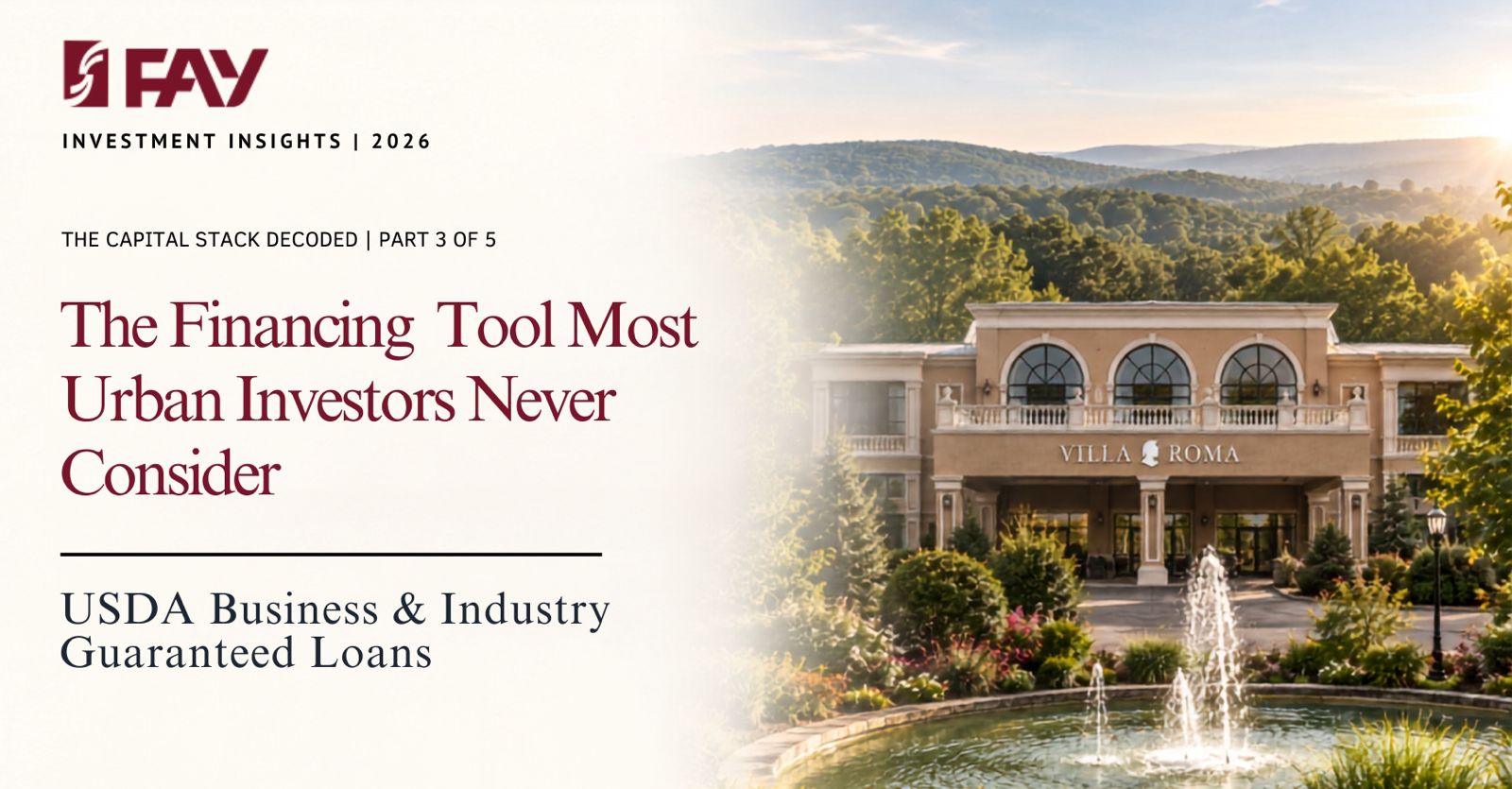
A precise account of how the USDA Business and Industry Guaranteed Loan Program works for hotel and integrated resort investment, what it costs, who qualifies, how it layers with other instruments, and why investors focused on drive-to leisure markets are leaving material capital efficiency on the table by not using it.
By Sandeep Wadhwa, Chairman, FAY Investment Group
1. The Program That Drive-To Leisure Investors Overlook
The USDA Business and Industry Guaranteed Loan Program is not a widely discussed instrument in hospitality investment circles. It does not appear in most hotel financing guides. Capital advisors who specialize in urban full-service hotels rarely mention it. For investors whose focus sits on coastal gateway markets, large convention cities, or urban boutique hotels, it is genuinely irrelevant. For investors focused on drive-to leisure markets, rural resort geographies, and the kind of integrated resort asset that sits at the intersection of hospitality and healthcare, it is among the most capital-efficient instruments in the entire financing landscape and it is almost universally overlooked.
The program’s eligibility boundary is a single criterion: communities with populations under 50,000. That threshold, applied to the US leisure resort map, covers a substantial and largely unexamined share of the drive-to leisure markets where integrated resort investment is most active. Take, for instance, Sullivan County and the broader Catskills corridor, two hours from New York City, squarely within the post-2020 domestic leisure recovery, and well within USDA eligibility. The same applies across most of the regional resort geographies that have driven leisure travel growth over the past five years: the Berkshires, the Virginia Blue Ridge, the Tennessee Smokies, and the mountain and lake corridors of the Mountain West. These are not marginal or remote markets. They are the drive-to leisure markets that institutional hospitality investors have been actively targeting, and the USDA eligibility boundary runs through virtually all of them.
USDA B&I financing is consistently the most underutilized instrument in the toolkit for rural and semi-rural resort investment. The program offers loan sizes that exceed SBA limits, guarantee structures that reduce lender risk below what SBA provides on larger loans, and terms that extend to 40 years on real estate. The timeline is the most common stated objection. It is a real constraint that requires planning. It is not a reason to ignore the program.
2. How the Program Works – The Guarantee Structure
The USDA does not lend money directly. It guarantees a portion of a loan made by an approved commercial lender. That guarantee is what gives the program its value: it reduces the lender’s risk exposure on the guaranteed portion, which allows the lender to extend more favorable terms, higher LTV, longer amortization, and tighter pricing than they would provide on the same asset without the guarantee.
The guarantee percentages for FY2026 are set by the USDA in an annual Federal Register notice. Applications requesting less than USD 5 million receive an 85 percent guarantee. Applications requesting USD 5 million or more receive an 80 percent guarantee. On a USD 10 million hotel loan, the USDA guarantees USD 8 million of the lender’s exposure. On a USD 4 million loan, the USDA guarantees USD 3.4 million. The lender retains the unguaranteed portion, which is the only part of the loan that carries full lender risk.
The practical effect on lender behavior is significant. A lender who would otherwise require 25 to 30 percent equity and apply a risk premium to a rural hotel loan will often lend at up to 80 percent LTV and at competitive rates when 80 to 85 percent of the loan is government-guaranteed. The guarantee does not eliminate lender scrutiny. It reduces lender risk, which translates directly into better terms for the borrower.
The guarantee fee is 3 percent of the guaranteed amount, charged upfront at closing. On a USD 10 million loan with an 80 percent guarantee, the fee is 3 percent of USD 8 million, or USD 240,000. This is a transaction cost that must be modeled at the outset. An annual renewal fee of 0.50 percent of the outstanding guaranteed balance is charged for the life of the loan. The rate in effect at origination remains fixed for the loan term. Both fees are the lender’s responsibility under program rules but are typically passed through to the borrower.
Interest rates are negotiated between the lender and borrower and are not capped by the USDA. Rates may be fixed, variable, or a combination. Variable rates may not adjust more often than quarterly. The negotiated rate on a USDA B&I loan typically reflects the lender’s reduced risk position. Borrowers with government-guaranteed exposure consistently report rates that are competitive with or below conventional hotel financing for equivalent collateral.
3. The Terms – What the Program Provides
Loan size reaches USD 25 million per project. The Secretary of Agriculture may approve amounts above USD 25 million in exceptional cases, though this is uncommon in practice. For comparison, SBA 504 is practically capped at USD 20 million in total project cost. USDA B&I covers the same use cases, acquisition, construction, renovation, equipment, and refinancing, at a larger loan size, making it the more appropriate instrument for integrated resort projects in the USD 15 million to USD 25 million range.
Loan terms reach 40 years on real estate. The program requires full amortization: no balloon payments and no call structures. Typical real estate terms run 25 to 30 years in practice, though the 40-year maximum exists and is used for projects where the longer amortization meaningfully improves debt service coverage. Equipment and machinery terms follow useful economic life, capped at 15 years. Working capital terms do not exceed 7 years.
LTV reaches 80 percent on hotel acquisitions in most states, with some states approving up to that level and others operating at 75 percent depending on the state USDA office’s assessment of local market conditions. Hotel purchases require 20 to 25 percent tangible equity, while hotel refinances typically require 10 percent equity. The equity requirement is higher than SBA 504 at 10 percent but lower than conventional hotel financing at 25 to 35 percent.
Use of proceeds covers acquisition and development of land and buildings, new construction, renovation, equipment, FF&E, working capital, and refinancing of existing debt that improves cash flow while creating or saving jobs. The breadth of eligible uses is one of the program’s practical advantages over SBA 504, which excludes working capital and FF&E. A USDA B&I loan can fund an integrated resort acquisition, the renovation program, equipment, FF&E, and a working capital reserve in a single instrument.
Prepayment is permitted. Prepayment penalties are allowed under program rules but are not mandatory. Lenders who intend to hold the loan to maturity, which is common for USDA B&I lenders given the guaranteed income stream, typically prefer no prepayment provisions or modest declining schedules. The absence of a structured 10-year prepayment lock is a material advantage over SBA 504 for investors who want exit flexibility during the hold period.
|
Parameter |
USDA B&I |
SBA 504 |
SBA 7(a) |
|---|---|---|---|
|
Maximum loan size |
USD 25 million |
USD 20 million total project |
USD 5 million |
|
Guarantee percentage |
80 to 85% depending on loan size (FY2026) |
75% of SBA portion (CDC debenture) |
75 to 85% depending on loan size |
|
LTV |
Up to 80% (hotel acquisition) |
Up to 90% |
Up to 85 to 90% |
|
Equity requirement (hotel purchase) |
20 to 25% |
10 to 15% (15 to 20% special purpose) |
10 to 15% |
|
Maximum term (real estate) |
40 years |
25 years (CDC portion) |
25 years amortization |
|
Use of proceeds |
Acquisition, construction, renovation, equipment, FF&E, working capital, refinancing |
Real estate and major fixed assets only |
Acquisition, working capital, PIP, FF&E, franchise fees |
|
Upfront guarantee fee |
3% of guaranteed amount |
No standard SBA guarantee fee on 504 portion in 2026 |
3.5 to 3.75% of guaranteed amount |
|
Annual renewal fee |
0.50% of outstanding guaranteed balance |
None |
None |
|
Geographic restriction |
Rural areas, population under 50,000 |
No geographic restriction |
No geographic restriction |
|
Owner-operator requirement |
No – passive investors and institutional capital eligible |
Yes – operator must manage hotel on-site |
Yes – operator must manage hotel on-site |
Source: USDA Rural Development official program page FY2026; USDA B&I FAQ; SBA.gov; PeerSense Capital Advisory May 2026; Peoples Bank Mortgage 2026 Edition. All parameters reflect FY2026 program terms effective May 27, 2026.
4. The Eligibility Framework – Three Gates
Three eligibility requirements determine whether a hospitality project qualifies for USDA B&I financing. All three must be satisfied before the application proceeds.
Geographic eligibility
The project must be located in a rural area. The USDA defines rural as communities with populations under 50,000. The USDA maintains an online eligibility mapping tool on the Rural Development website where any address can be checked against the current eligibility boundaries. The definition is applied to the community where the project is located, not the borrower’s headquarters. A hotel developer headquartered in New York City qualifies for USDA B&I financing if the hotel project is located in an eligible rural community.
For investors focused on drive-to leisure markets, the geographic gate is frequently passable. Sullivan County in New York qualifies. The Catskills region qualifies broadly. Comparable resort geographies in the Northeast Berkshires, the Virginia Blue Ridge, the Tennessee Smokies, the Colorado mountain corridor below 50,000 residents, and most regional leisure markets in the Southeast and Mountain West qualify. A transaction team that spends two minutes on the USDA Rural Development eligibility map will find that more of their target deal flow sits inside the program boundary than outside it.
Business and borrower eligibility
The borrower must operate a for-profit business. Eligible entity types include partnerships, individuals, cooperatives, for-profit and nonprofit corporations, publicly traded companies, tribal groups, and public bodies. There is no owner-operator requirement. Passive investors, family office holdcos, institutional real estate funds, and joint ventures all qualify as borrowers, provided the business is for-profit and located in an eligible rural area. This is the most significant structural difference between USDA B&I and SBA programs. Capital organized for passive investment, which is excluded from SBA by the owner-operator requirement, is eligible for USDA B&I.
There is no SBA-style small business size standard. Any size business may be eligible. A portfolio investor with multiple hotel assets, revenues above the SBA size threshold, or a complex ownership structure that disqualifies SBA access can still qualify for USDA B&I, provided the project is in an eligible geography and the business purpose meets program criteria.
Use of proceeds eligibility
The loan must be used to improve, develop, or finance business, industry, and employment, and improve the economic and environmental climate in rural communities. For hotel and resort investment, this means acquisition, construction, renovation, equipment, FF&E, and refinancing all qualify. The business purpose test is not restrictive for commercial hospitality investment. A hotel project that creates or retains jobs in a rural community meets the program’s stated economic development objective, which is why the program has been widely used for rural hospitality investment since its establishment.
5. The Advantage Over Conventional Financing – Three Specific Benefits
The USDA B&I guarantee produces three specific and measurable advantages over conventional hotel financing in eligible markets.
Lenders continue to lend when conventional capital pulls back. As Thomas Kimsey, president and CEO of Thomas USAF Group, which manages over USD 100 million in annual loan originations including USDA B&I, noted in Hotels magazine: most traditional lenders have pulled back in the current environment. The USDA loan is one of the few products where the lender continues to lend because of the 80 percent government guarantee. In a financing environment where conventional hotel construction lending is constrained by elevated construction costs, tighter DSCR requirements, and lender caution on new hospitality supply, the USDA guarantee sustains lender participation at LTV levels and terms that conventional programs do not currently offer.
Competitive rates and extended terms. Fixed interest rates add predictability in a fluctuating interest rate environment, making USDA B&I a strategic choice for hotel developers and investors who want to lock long-term financing certainty on a rural resort asset. A 25 to 30-year fixed rate on a hotel acquisition, at rates that reflect the reduced lender risk from the government guarantee, produces a debt service profile that competes directly with CMBS permanent financing while retaining the use-of-proceeds flexibility that CMBS does not offer.
Capital stack optimization when combined with other instruments. When integrated into a capital stack alongside tools like C-PACE financing and New Market Tax Credits, USDA loans optimize financial leverage, reduce reliance on higher-cost capital, and potentially enhance project returns, as Sok Cordell, senior managing director at CH Capital Partners, observed in Hotels magazine. C-PACE covers the eligible building systems at 6.5 to 7.5 percent fixed. USDA B&I covers the acquisition and renovation at up to 80 percent LTV with the government guarantee improving lender terms. The equity requirement on the combined stack drops materially below what either instrument produces alone, and the blended cost of capital is consistently lower than conventional senior debt plus mezzanine equivalents.
6. The Timeline – The Real Constraint and How to Manage It
The most consistent objection to USDA B&I financing in a competitive acquisition process is timeline. The objection is valid. The program does not close in 30 days. Managing it correctly reduces the timeline concern from a deal-breaker to a planning requirement.
Applications are submitted to USDA Rural Development state and area offices based on the project location. Most state offices have authority to approve guarantees on loans up to USD 5 to USD 10 million. Loans exceeding state office authority are processed at the state level and submitted to the national office. The processing timeline is typically 90 to 180 days from a complete application to guarantee issuance, with well-organized applications in states with active B&I programs at the lower end of that range.
The implication for transaction structuring is direct. USDA B&I is not the instrument for a 45-day close on a competitive off-market acquisition. It is the instrument for acquisitions identified with sufficient lead time, development projects where the financing structure is designed before the land or asset is under contract, and refinancing transactions where the current debt maturity provides adequate runway to complete the application process.
The investor who builds USDA B&I eligibility assessment into their pre-acquisition diligence, rather than after a purchase agreement is signed, eliminates the timeline objection. The investor who identifies a target market, checks the eligibility map, engages a USDA-approved lender before the specific asset is identified, and completes the application package in parallel with the acquisition process can close USDA-financed transactions on timelines that do not materially disadvantage the acquisition.
The documentation requirement is substantial but standardized. Financial statements for two to three years, business plan with projections, feasibility analysis, appraisal, environmental review, and evidence of job creation or retention are standard components. The state USDA field office assigns a loan specialist to each application who works with the borrower and lender through the review. That relationship is a practical asset. The loan specialist’s guidance on application completeness reduces revision cycles and timeline variance.
7. USDA B&I in the Layered Capital Stack
USDA B&I reaches its full capital efficiency potential when it is one layer in a coordinated stack rather than a standalone instrument. Two combinations are particularly relevant for integrated resort investment in eligible geographies.
C-PACE plus USDA B&I is the combination that produces the most significant equity reduction available to an institutional investor in a USDA-eligible market. C-PACE finances the eligible building systems portion, HVAC, building envelope, electrical systems, roofing, plumbing, at 6.5 to 7.5 percent fixed, secured by a property tax assessment that sits outside the mortgage lien structure. USDA B&I provides up to 80 percent LTV on the acquisition and broader renovation scope, with the government guarantee improving lender terms. On an integrated resort project where C-PACE covers 20 to 25 percent of total cost, the combined equity requirement drops to 10 to 15 percent of total project cost. That equity efficiency is not achievable through any conventional financing combination in the same market.
USDA B&I plus conventional bridge is the right sequence for value-add resort acquisitions where the asset is below stabilized performance at acquisition. USDA B&I provides the acquisition and renovation financing at 80 percent LTV with favorable terms. Once the asset reaches stabilized performance, the investor refinances into CMBS permanent financing at institutional scale. The absence of a mandatory prepayment penalty on USDA B&I provides the exit flexibility that SBA 504’s 10-year declining structure does not.
8. Conclusion – The Right Geography Unlocks the Right Instrument
USDA B&I financing is not for every hospitality investor. It is precisely the right instrument for investors whose target geography is the drive-to leisure market, the regional resort corridor, and the integrated resort asset in a rural community within reach of a major metropolitan demand pool.
The program offers loan sizes up to USD 25 million, terms to 40 years, government guarantee structures that reduce lender risk and improve terms, and use-of-proceeds flexibility that covers the full acquisition and development stack including working capital and FF&E. It is available to passive investors and institutional capital, with no owner-operator requirement. It combines effectively with C-PACE financing to reduce equity requirements below what any other financing combination provides in eligible markets.
The timeline requires planning. The documentation requires organization. Neither is a structural barrier for an investor who builds the program into their pre-acquisition process rather than discovering it after a contract is signed.
FAY Investment Group is evaluating this framework as part of its financing strategy for The Villa Roma Resort in Callicoon, Sullivan County, New York. The property qualifies for USDA rural designation, falls within an active C-PACE state, and represents the kind of established integrated resort asset where a layered capital stack, built from government-guaranteed debt, property-assessed clean energy financing, and disciplined equity, is designed to produce a materially more efficient structure than conventional financing alone. The remaining articles in this series examine CMBS financing for hotels and the complete layered stack in depth.
About the Author
Sandeep Wadhwa is Chairman of FAY Investment Group, with over two decades of experience in hospitality and real estate investing. He has led multi-billion-dollar transactions and managed complex assets across global markets. His approach focuses on discipline, execution, and long-term value creation.