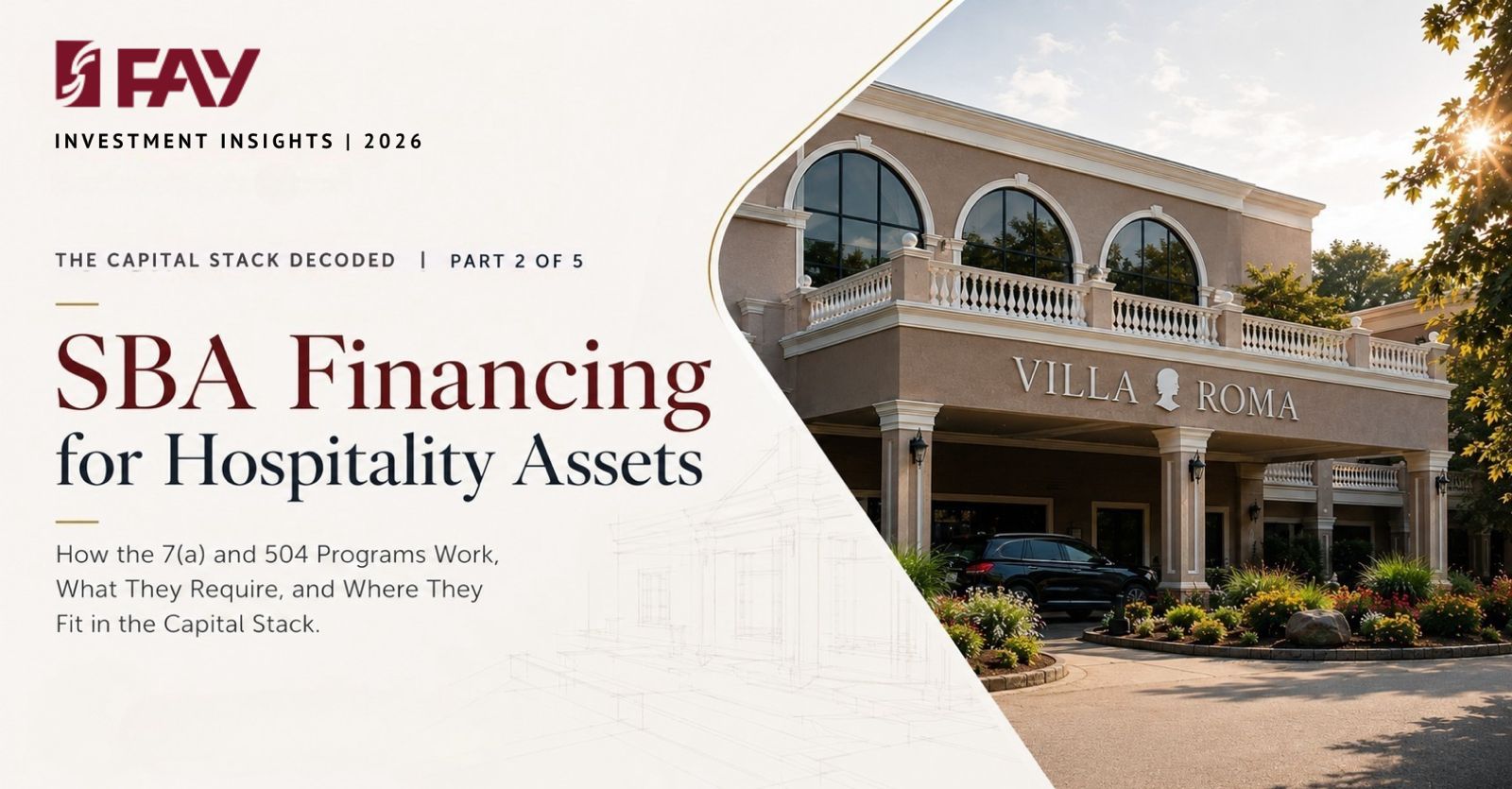
A precise account of how SBA 7(a) and SBA 504 work in hotel financing, how they differ, what the July 4, 2026 limit expansion changes for mid-market hospitality transactions, and how each program fits inside a layered capital stack.
By Sandeep Wadhwa, Chairman, FAY Investment Group
1. The Most Misunderstood Financing Tool in Hospitality
SBA financing is the instrument most hospitality investors know exists yet few fully understand from a structural standpoint. The dismissal usually takes one of two forms. The first is that SBA is only for small businesses running small projects. The second is that it is too slow for a competitive acquisition process. Neither assumption holds up under closer examination, and both stem from an incomplete understanding of how the programs actually work.
The reality is straightforward. SBA 504 can finance hotel projects totaling up to approximately USD 20 million in total project cost. Following the July 4, 2026 program expansion, SBA 7(a) and SBA 504 can together provide up to USD 10 million in government-backed financing to a single qualifying borrower. For eligible owner-operators, SBA 504 supports leverage of up to 90 percent LTV, a level unmatched by conventional hotel lenders, CMBS conduits, or bridge financing.
SBA financing is often dismissed for reasons that rarely withstand detailed analysis. The belief that a project is “too large” is inaccurate for many mid-market hotel acquisitions. Likewise, concerns about execution speed usually reflect late preparation rather than limitations of the program itself. Borrowers who incorporate SBA financing into their underwriting before identifying a target asset are typically able to manage the timeline far more effectively than those who begin the process after signing a purchase agreement.
2. Two Programs, Fundamentally Different Purposes
The first structural error many investors make is treating SBA 7(a) and SBA 504 as interchangeable solutions. They are designed for different financing objectives, with distinct rate structures, permitted uses of proceeds, prepayment provisions, and roles within the capital stack. Selecting the wrong program increases financing costs. Selecting the right one—or combining both where appropriate, creates a capital structure that conventional lending alone cannot replicate.
SBA 7(a) — The Flexible Single-Instrument Tool
7(a) is a single-lender loan originated by an SBA-approved bank, with the SBA guaranteeing up to 75 percent of loans above USD 150,000. The borrower works with one lender, one loan, and one closing. That simplicity is one of the program’s defining advantages, particularly for transactions requiring multiple funding components.
Maximum loan size is USD 5 million per program. Rates are variable at Prime plus 2.25 to 3.0 percent. With Prime at 6.75 percent, effective borrowing rates currently range from 9.0 to 11.5 percent, resetting quarterly. Because the rate moves with Prime, borrowers should evaluate interest-rate risk alongside the program’s flexibility. LTV reaches 85 percent for qualified owner-operators, with some lenders extending to 90 percent for exceptionally strong sponsor profiles. Amortization runs 25 years on the real estate component, with a 10-year loan term.
The defining advantage of 7(a) lies in its permitted use of proceeds. Unlike most commercial real estate loans, it allows acquisition costs, working capital, PIP renovations, FF&E, franchise initiation fees, soft costs, and even debt consolidation to be financed within a single structure. An investor acquiring a USD 3 million hotel with a USD 800,000 PIP budget and USD 400,000 in working capital requirements can bundle all three into one USD 4.2 million 7(a) loan through a single lender and closing.
The prepayment structure is particularly well suited to value-add strategies. Its three-year declining penalty (5-3-1 percent) allows investors to refinance or exit without penalty from year four onward. For sponsors planning to acquire, renovate, stabilize, and refinance or sell within three to five years, this flexibility is often more valuable than a lower fixed interest rate. The upfront guarantee fee of 3.5 to 3.75 percent of the guaranteed portion should be treated as a transaction cost during underwriting.
Closing timelines generally range from 30 to 90 days for a well-prepared application. With only one lender and one approval process, execution is typically faster than the SBA 504 structure.
SBA 504 — The Long-Term Fixed-Rate Real Estate Instrument
SBA 504 follows a three-party structure. A conventional bank provides 50 percent of project cost through a first mortgage. A Certified Development Company (CDC) finances 40 percent through an SBA-backed debenture, while the borrower contributes 10 percent equity, increasing to 15–20 percent for special-purpose properties such as hotels. This structure supports total project sizes of approximately USD 20 million, based on the CDC’s USD 5 million maximum participation.
The rate structure is what distinguishes SBA 504 for long-term ownership. The bank’s first mortgage carries either a floating rate or a market-based fixed rate for five to ten years, generally between 7.5 and 9.5 percent. The CDC debenture is fixed for 20 to 25 years at approximately 5.5 to 7.0 percent, with rates established monthly under the SBA formula. Together, the two notes currently produce an effective blended borrowing cost of roughly 8.5 to 9.5 percent, while providing long-term rate certainty that few conventional hotel lenders can match.
For qualifying owner-operators, SBA 504 also offers up to 90 percent LTV, substantially reducing the equity required at acquisition. Conventional hotel financing typically requires 25 to 35 percent equity, whereas SBA 504 often requires only 10 percent. On a USD 10 million acquisition, that difference preserves between USD 1.5 million and USD 2.5 million of investor capital that can instead fund working capital, PIP reserves, or future acquisitions.
Use of proceeds is more restrictive than under 7(a). Funding is limited to real estate, construction, and major fixed assets. Working capital, FF&E, and franchise-related soft costs are excluded. Projects requiring those elements must either supplement the financing with SBA 7(a) or provide additional equity. This distinction is one of the most common sources of structuring errors in SBA applications.
The prepayment structure is the program’s principal limitation for shorter investment horizons. The declining penalty extends over ten years, making early refinancing or disposition considerably more expensive than under SBA 7(a). Investors pursuing a three-to-five-year value-add strategy should model this cost carefully before selecting the program.
Closing generally takes between 60 and 120 days. The involvement of both a conventional lender and a CDC naturally extends execution by approximately two to four weeks compared with SBA 7(a). Although SBA 504 is often perceived as more difficult to qualify for, the difference lies primarily in process rather than underwriting standards. Well-prepared borrowers who provide complete documentation can generally meet standard transaction timelines.
Factor | SBA 7(a) | SBA 504 |
|---|---|---|
Maximum loan | USD 5 million per program | USD 20 million total project (USD 5M CDC portion) |
Structure | Single lender, single note, single closing | Three parties: bank (50%) + CDC (40%) + borrower equity (10%) |
Rate | Variable: Prime + 2.25 to 3.0%; effective 9.0 to 11.5% | Fixed 20-25 years on CDC portion at 5.5 to 7.0%; blended 8.5 to 9.5% |
LTV | Up to 85% (90% for strong sponsors) | 90% — highest in US hotel CRE financing |
Use of proceeds | Acquisition, working capital, PIP, FF&E, franchise fees, soft costs | Real estate and major fixed assets only; no working capital or FF&E |
Prepayment | 3-year declining (5-3-1%); clean exit from year 4 | 10-year declining; significant cost to refinance or sell early |
Equity requirement | 15% typical; 10% possible for strong sponsors | 10% standard; 15 to 20% for special-purpose hotel properties |
Closing timeline | 30 to 90 days | 60 to 120 days |
Best for | Under USD 5M; bundled acquisition + working capital + PIP; stabilize and sell | USD 5M to USD 20M; real-estate-heavy; long-term hold; fixed-rate certainty |
Source: PeerSense Capital Advisory, May 2026; Peoples Bank Mortgage, SBA Hotel Loans 2026 Edition; Crestmont Capital Hotel Financing Guide; SBA.gov official program pages.
3. The July 4, 2026 Expansion — What Changed and Why It Matters
On May 18, 2026, the SBA announced one of the most significant policy changes affecting hospitality financing in recent years. Effective July 4, 2026, the cumulative combined limit on SBA 7(a) and SBA 504 loans doubled from USD 5 million to USD 10 million per borrower. Previously, borrowers had to share a single cumulative limit across both programs. Under the revised policy, each program now operates with its own independent maximum, substantially expanding financing flexibility for qualifying owner-operators.
The implications for mid-market hospitality investors are significant. A buyer acquiring a USD 12 million hotel with a USD 1.5 million PIP can now structure up to USD 5 million through SBA 7(a) for the acquisition, working capital, and renovation costs, alongside another USD 5 million through SBA 504 for the real estate component. That financing structure was not available before July 4, 2026. In this example, USD 10 million of government-backed financing supports a USD 13.5 million project, materially reducing the equity requirement while preserving flexibility across different project costs.
One operational consideration remains. Where both programs are used together, the SBA 7(a) approval must precede, or occur concurrently with, the SBA 504 approval. Investors and lenders should incorporate that sequencing requirement into their transaction planning to avoid unnecessary delays during closing.
4. The Four Eligibility Gates
Before underwriting begins, four threshold questions determine whether a transaction qualifies for SBA financing. If any one of these requirements is not met, the application cannot proceed regardless of the project’s financial strength.
Owner-operator requirement
At least 51 percent of the hotel must be occupied by the borrower’s operating business, and the borrower must actively manage the property. Passive investors, family office holding companies, REITs, and absentee owners do not qualify. The SBA evaluates operational control rather than ownership percentage alone. Personal guarantees are required from every owner holding 20 percent or more of the borrowing entity, making the financing fully recourse at the personal level.
Business size standards
Borrowers must qualify as small businesses under SBA size standards. For most hotel accommodation NAICS classifications, the current threshold is annual revenue below USD 47 million. Eligibility is assessed on a consolidated basis across affiliated entities, meaning a larger hotel portfolio may exceed the limit even if the individual acquisition qualifies on its own. Sole proprietorships, partnerships, LLCs, and corporations are all eligible provided they satisfy the applicable size requirements.
Property type eligibility
Traditional hotels, motels, inns, resorts, bed-and-breakfasts, and extended-stay properties all qualify. Mixed-use assets remain eligible where the hotel represents the primary business activity and the owner actively operates at least 51 percent of the property. Franchise affiliation does not affect eligibility, although the franchise agreement must be reviewed and the brand must appear on the SBA’s approved franchise directory. Independent boutique hotels are evaluated under the same eligibility framework as branded properties.
Use of proceeds
The financing program must align with the intended use of proceeds. SBA 7(a) supports acquisition costs, working capital, FF&E, and renovation expenses, whereas SBA 504 is limited to real estate and major fixed assets. Attempting to finance ineligible expenses through SBA 504 is one of the most common reasons applications fail during underwriting. Matching the financing structure to project requirements before submitting an application avoids unnecessary delays and restructuring.
5. The Decision Framework — Which Program, When
Selecting between SBA 7(a) and SBA 504 is ultimately driven by four considerations: project size, use of proceeds, interest-rate preference, and intended holding period.
Choose SBA 7(a) when the project is under USD 5 million, working capital or a PIP must be financed alongside the acquisition, the expected hold period is three to five years, or execution speed and a single-lender structure are priorities. Its three-year declining prepayment penalty makes it particularly well suited to acquisition, stabilization, and refinancing strategies, including those that ultimately transition into CMBS permanent financing.
Choose SBA 504 when the project ranges from approximately USD 5 million to USD 20 million, real estate represents the dominant funding requirement, the investment horizon extends beyond ten years, and long-term fixed-rate certainty is a priority. The blended borrowing cost currently sits approximately 150 to 250 basis points below SBA 7(a), creating meaningful debt service savings over longer holding periods. On a USD 10 million acquisition, that spread can translate into several hundred thousand dollars of cumulative savings over ten years.
Choose a combined structure, following the July 2026 policy change, when projects fall within the USD 7 million to USD 12 million range and costs can be clearly separated between the real estate component (SBA 504) and working capital or PIP expenditures (SBA 7(a).) Although coordinating two programs and two lenders increases execution complexity, the resulting reduction in required equity often justifies the additional effort.
6. Where SBA Fits in the Layered Capital Stack
SBA financing creates the greatest value when integrated into a broader capital strategy rather than used as a standalone funding source. Two combinations are particularly relevant for hospitality investors.
C-PACE + SBA 504
For qualifying owner-operators, combining C-PACE with SBA 504 represents one of the most capital-efficient financing structures currently available. C-PACE funds eligible building systems—including HVAC, roofing, electrical infrastructure, and the building envelope—at long-term fixed rates secured through a property tax assessment rather than a traditional mortgage lien. SBA 504 provides up to 90 percent LTV on the real estate component.
Where C-PACE-eligible improvements represent 20–25 percent of total project cost, the combined structure can reduce overall equity requirements to below 10 percent while preserving long-term fixed-rate financing. Few conventional financing alternatives deliver comparable capital efficiency.
SBA 7(a) + Conventional or CMBS
SBA 7(a) is often the preferred financing tool for value-add acquisitions that will later transition into permanent financing. The program supports acquisition and renovation while the asset is below the occupancy and debt-yield thresholds required for CMBS underwriting. Once operations stabilize, the borrower refinances into CMBS non-recourse debt.
The relatively short three-year prepayment period makes this transition economically practical, whereas the longer SBA 504 prepayment schedule is generally less suited to value-add exit strategies.
The sequencing discipline matters. Few financing programs combine up to 90 percent leverage, working capital flexibility, long-term amortization, and the ability to refinance within a relatively short holding period. For qualifying owner-operators, that combination makes SBA financing a unique component within a layered hospitality capital stack rather than simply another lending option.
7. The Documentation Requirement — Where Applications Succeed and Fail
The SBA application itself is straightforward. What determines execution success is the quality and completeness of the supporting documentation. Most hotel applications stall because of documentation gaps rather than eligibility issues.
At a minimum, both SBA 7(a) and SBA 504 require two to three years of personal and business tax returns, personal financial statements, the purchase agreement or refinance terms, hotel operating history (including STR data where available), and a business plan supported by financial projections. For SBA 504 transactions involving renovations, firm fixed-price contractor bids are essential. Preliminary estimates or informal quotations are generally insufficient. Franchise-affiliated hotels must also submit the franchise agreement, and the brand must appear on the SBA’s approved franchise directory.
Environmental reviews can also influence transaction timelines, particularly for older hospitality assets. Phase I environmental assessments are standard, while properties with identified concerns may require a Phase II investigation, extending the approval process by several weeks. Commissioning the Phase I assessment early can significantly reduce avoidable delays.
One of the most common reasons SBA hotel transactions encounter delays is not underwriting complexity but preparation. Typical issues include engaging an SBA lender too late, relying on overly optimistic operating projections, and failing to demonstrate sufficient hotel management experience. Even well-prepared applications generally require 30 to 90 days to close. Accordingly, borrowers should engage an SBA-preferred lender before identifying a target property rather than after signing a purchase agreement with an aggressive closing schedule.
One additional underwriting consideration is particularly relevant to SBA 504 transactions. Renovation budgets should be substantially complete before submission, as material scope changes after approval can delay closing. Underwriters typically include a contingency of 10 to 15 percent for construction costs. Changes exceeding that allowance often require amendments and may trigger additional review. Finalising contractor bids and renovation specifications before filing materially improves execution certainty.
8. Conclusion — The Highest-LTV Tool in the Market, Used by Too Few
SBA financing is routinely positioned in the hospitality market as a fallback for borrowers who cannot qualify for conventional financing. That framing is wrong, and the cost of holding it is measurable.
SBA 504 delivers 90 percent LTV, the highest in all of US hotel commercial real estate. The 25-year fixed rate on the CDC debenture is among the lowest long-term financing available for hospitality assets in the current market. The July 4, 2026 expansion to a combined USD 10 million limit opens the program to a meaningfully wider range of mid-market transactions. The program is available not because a borrower cannot access conventional financing, but because an owner-operator who meets the eligibility criteria can access better financing terms than any conventional lender will provide on equivalent collateral.
The investor who treats SBA as a capital efficiency tool, layered with C-PACE where the improvement scope qualifies and sequenced into CMBS permanent financing where the hold strategy warrants it, consistently deploys less equity per dollar of asset controlled than the investor using conventional financing alone. That equity efficiency compounds across a portfolio. It is not a small program for small investors. It is a precision instrument for disciplined capital allocation.
FAY Investment Group will be applying this framework to its hospitality investment program. The Villa Roma Resort in Callicoon, Sullivan County, New York is located in a geography that qualifies for SBA owner-operator financing, a 434-acre integrated resort asset in a drive-to leisure market within reach of the northeast’s primary metropolitan demand pool. The articles that follow in this series examine the USDA Business and Industry Guaranteed Loan program, CMBS financing for hotels, and the complete layered capital stack in depth.
About the Author
Sandeep Wadhwa is Chairman of FAY Investment Group, with over two decades of experience in hospitality and real estate investing. He has led multi-billion-dollar transactions and managed complex assets across global markets. His approach focuses on discipline, execution, and long-term value creation.


USDA Business and Industry Guaranteed Loans for Hotels & Resorts (2026 Guide)
[…] offers loan sizes that exceed SBA limits, guarantee structures that reduce lender risk below what SBA provides on larger loans, and terms that extend to 40 years on real estate. The timeline is the most common […]
Navigating SBA Loans for Hotel Acquisition: A Guide for Real Estate Professionals - Thornecre
[…] SBA Hotel Financing: 7(a) vs 504 Loans for Hospitality Assets — fayinvestment.comSBA 7(a) supports acquisition costs, working capital, FF&E, and renovation expenses, whereas SBA 504 is limited to real estate and major fixed … […]
SBA Loan for Hotel Acquisition: Complete Guide for Real Estate Investors and Lenders - Thornecre
[…] SBA Hotel Financing: 7(a) vs 504 Loans for Hospitality Assets — fayinvestment.comSBA 7(a) supports acquisition costs, working capital, FF&E, and renovation expenses, whereas SBA 504 is limited to real estate and major fixed … […]
SBA 504 vs. CMBS Loans for Hotel Financing: Strategic Capita
[…] SBA Hotel Financing: 7(a) vs 504 Loans for Hospitality Assets — fayinvestment.comFor eligible owner-operators, SBA 504 supports leverage of up to 90 percent LTV, a level unmatched by conventional hotel lenders, CMBS conduits … […]
SBA Loan Guidelines for Unflagged Hotels: Underwriting Crite
[…] SBA Hotel Financing: 7(a) vs 504 Loans for Hospitality Assets — fayinvestment.comSBA 504 can finance hotel projects totaling up to approximately USD 20 million in total project cost. Borrowers must qualify as small … […]
SBA 7(a) vs. SBA 504 for Hotel Franchise Acquisition: Side-b
[…] SBA Hotel Financing: 7(a) vs 504 Loans for Hospitality Assets — fayinvestment.comConventional hotel financing typically requires 25 to 35 percent equity, whereas SBA 504 often requires only 10 percent. On a USD 10 million … […]
Preferred SBA Lenders for Hotel Acquisition: A Guide for Bro
[…] SBA Hotel Financing: 7(a) vs 504 Loans for Hospitality Assets — fayinvestment.comCompare SBA 7(a) and SBA 504 hotel loans, eligibility, LTV, rates, documentation, and the 2026 loan limit expansion for hospitality financing. […]
Top Preferred SBA Lenders for Hotel Acquisitions: 2026 Strat
[…] SBA Hotel Financing: 7(a) vs 504 Loans for Hospitality Assets — fayinvestment.com## SBA Financing for Hospitality Assets: How the 7(a) and 504 Programs Work, What They Require, and Where They Fit in the Capital Stack ### **2. Two Programs, Fundamentally Different Purposes** #### **SBA 504 — The Long-Term Fixed-Rate Real Estate Instrument** | **Factor** | **SBA 7(a)** | **SBA 504** | |-|-|-| | LTV | […]
SBA 504 Loan vs. PIP Financing for Hotel Renovation: A Strat
[…] SBA Hotel Financing: 7(a) vs 504 Loans for Hospitality Assets — fayinvestment.com## SBA Financing for Hospitality Assets: How the 7(a) and 504 Programs Work, What They Require, and Where They Fit in the Capital Stack ### **2. Two Programs, Fundamentally Different Purposes** #### **SBA 504 — The Long-Term Fixed-Rate Real Estate Instrument** A Certified Development Company (CDC) finances 40 percent t […]