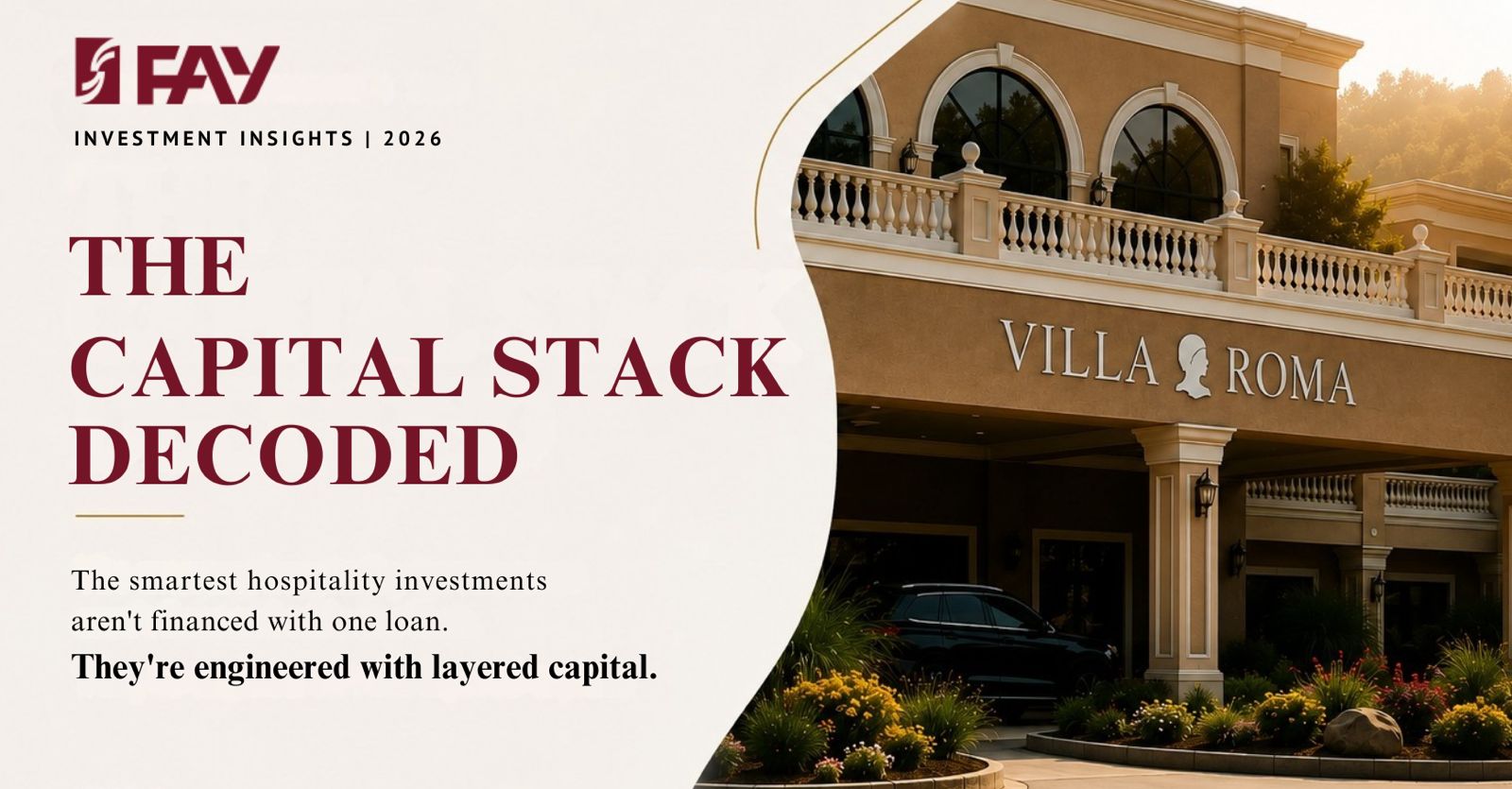
A guide to C-PACE, SBA, USDA, and CMBS financing, what each instrument does, where it sits in the capital stack, and how layering them reduces blended cost of capital and improves equity returns in US hospitality investment.
1. The Financing Gap Most Investors Leave on the Table
Most hospitality investors approach financing as a two-instrument problem. Senior debt from a bank or a CMBS conduit on one side. Equity on the other. The gap between the two gets filled with more equity, or with mezzanine debt priced at 10 to 15 percent. That is an expensive way to capitalize a project, and it is not the full picture. The US hospitality financing landscape includes at least five distinct instruments, each with specific eligibility criteria, cost of capital, and positioning in the capital stack. C-PACE financing, SBA 7(a) and 504 programs, USDA Business and Industry guaranteed loans, and CMBS permanent debt each occupy a different layer of the stack and serve a different function. Used in isolation, each has limitations. When thoughtfully combined, however, they create a capital structure that lowers the blended cost of capital, reduces equity requirements, and enhances investor returns compared to the conventional debt-and-equity model. The biggest financing challenge has rarely been a shortage of capital. Instead, it is a lack of awareness of the financing tools available. Equity is routinely deployed where government-guaranteed debt or property-assessed financing could have served at a materially lower cost. Investors who understand the full financing landscape consistently structure more efficient capital stacks than those relying solely on conventional debt and equity. The most persistent financing gap in hospitality investment is not access to capital. It is familiarity with the instruments available.
2. The Five Instruments — A Navigation Map
Before examining how these instruments combine, each deserves a precise description. Let us explore each financing option in detail and understand how they fit together within a hospitality capital stack.
SBA 7(a)
SBA 7(a) is the most flexible government-backed instrument. A single lender provides up to USD 5 million, covering acquisition, working capital, property improvement plans, and FF&E in one structure. Rates are variable at Prime plus 2.25 to 3.0 percent, currently producing effective rates of 9.0 to 11.5 percent with Prime at 6.75 percent. LTV reaches 85 percent for qualified owner-operators. Its greatest strength is flexibility, allowing borrowers to consolidate multiple funding needs into a single financing structure and lender relationship.
SBA 504
SBA 504 is a real-estate-focused two-lender structure. A conventional bank provides 50 percent as a first mortgage. A Certified Development Company provides 40 percent through an SBA-backed debenture at a fixed rate of 5.5 to 7.0 percent for 20 or 25 years. The borrower contributes 10 to 15 percent equity, rising to 15 to 20 percent for special-purpose properties including hotels. Total LTV reaches 90 percent. One of its biggest advantages is the long-term fixed-rate CDC debenture, which remains among the lowest-cost financing options available for hospitality real estate. As of July 4, 2026, the SBA doubled the cumulative combined limit on 7(a) and 504 loans to USD 10 million per borrower, decoupling the two programs and significantly expanding the usable range for mid-market hospitality transactions.
USDA Business & Industry Guaranteed Loans
USDA Business and Industry Guaranteed Loans operate in rural markets, defined as communities with populations under 50,000. The USDA guarantees 85 percent of loans under USD 5 million and 80 percent of loans at USD 5 million or above, for FY2026. Maximum loan amounts reach USD 25 million. Terms extend to 40 years on real estate. The guarantee fee is 3 percent of the guaranteed amount upfront, with an annual renewal fee of 0.50 percent. Rates are negotiated between lender and borrower and are not capped, but the federal guarantee substantially reduces lender risk, often resulting in more competitive terms than conventional financing for eligible projects. The instrument is available for acquisition, construction, renovation, equipment, and refinancing.
CMBS
CMBS (Commercial Mortgage-Backed Securities) loans are non-recourse, fixed-rate senior debt originated by conduit lenders and sold to investors as bonds. For hotel assets in 2026, rates range from 6.5 to 9.0 percent depending on flag, service level, and DSCR. Standard LTV runs 60 to 65 percent, with well-qualified flagged assets reaching 70 percent. Minimum loan size is USD 2 million with no stated maximum. The binding underwriting constraint for hotels is debt yield, not LTV: conduit lenders require 9 to 11 percent debt yield depending on asset type. CMBS is best suited to stabilized, institutional-quality hospitality assets held for the long term. Its structural rigidity, defeasance or yield maintenance prepayment provisions, and non-recourse character make it the right instrument for long-term holds and institutional exits, but less suitable for transitional or value-add properties.
C-PACE
C-PACE (Commercial Property Assessed Clean Energy) is a financing mechanism enabled by state legislation that covers energy-efficient improvements affixed to the building, including HVAC systems, roofing, building envelope, electrical systems, lighting, elevators, and plumbing. C-PACE is active in 40 states with over 32 active programs as of 2026. Rates are fixed at a spread over the 10-year Treasury, currently in the 6.5 to 7.5 percent range. Terms run 25 to 30 years. The instrument is non-recourse and secured by a property tax assessment rather than a traditional mortgage lien. The average C-PACE deal size has grown from approximately USD 800,000 in 2017 to USD 40 million in 2026, reflecting its adoption at institutional scale. Annual volume also grew 63 percent in 2025, increasing from USD 2.2 billion to USD 3.66 billion, underscoring its rapid acceptance among institutional hospitality investors.
| Instrument | Best-Fit Use Case | LTV Range | Rate Range (2026) | Recourse | Key Constraint |
|---|---|---|---|---|---|
| SBA 7(a) | Owner-operator acquisition under USD 5M; working capital + PIP bundle | Up to 85% | 9.0 to 11.5% variable | Full personal guarantee | Owner-operator requirement; USD 5M per program limit |
| SBA 504 | Real-estate-heavy acquisition USD 7M to USD 20M; long-term fixed rate | Up to 90% | 5.5 to 7.0% fixed (CDC portion); blended 7 to 9% | Personal guarantee on all 20%+ owners | Owner-operator; special-purpose hotel requires 15 to 20% equity |
| USDA B&I | Rural market acquisition, construction, or refinancing USD 5M to USD 25M | Up to 80% | Negotiated; competitive with conventional senior debt | Full recourse; guaranteed by USDA | Rural area eligibility (population under 50,000); 90 to 180-day processing |
| CMBS | Stabilized hotel USD 5M+; non-recourse permanent debt; institutional exit | 60 to 70% | 6.5 to 9.0% fixed | Non-recourse (bad-boy carveouts) | Debt yield floor 9 to 11%; stabilized asset required; defeasance prepayment |
| C-PACE | Energy and building systems in new construction or renovation; any qualifying hotel | 20 to 35% of value | 6.5 to 7.5% fixed | Non-recourse (property tax assessment) | Eligible improvements only; FF&E excluded; active in 40 states; senior lender consent required |
Source: SBA.gov, USDA Rural Development FY2026 guarantee rates, PeerSense Hotel Lenders 2026, Mayer Brown C-PACE and Hospitality June 2026, Bridge Marketplace Hotel Financing Guide 2026. All rates reflect mid-2026 market conditions.
3. Why These Instruments Are Complementary, Not Competitive
The most important insight about this financing landscape is not simply understanding each financing option individually, but recognising how they work together. These instruments do not compete for the same position in the capital stack. They occupy different layers, carry different risk profiles, and serve distinct functions. When structured together, they create a more efficient financing strategy than relying on any one instrument alone. C-PACE sits in a junior position secured by a property tax assessment rather than a mortgage lien. It finances the eligible building systems portion of a project without displacing or subordinating senior debt. Senior lender consent is required, but has become increasingly common as C-PACE adoption has grown. What C-PACE does is reduce the equity requirement for eligible improvements while providing long-term, fixed-rate financing that typically costs 200 to 300 basis points less than mezzanine debt. Importantly, it achieves this without reducing senior debt capacity. USDA B&I is senior guaranteed debt. Rather than replacing conventional senior financing, it strengthens it. By reducing lender risk through the government guarantee, it often enables lenders to offer higher leverage and more competitive pricing than they otherwise would. A lender who might require 25 to 30 percent equity and charge a 100 to 150 basis point risk premium on a rural hotel project will often lend at 80 percent LTV with tighter pricing when 80 to 85 percent of the loan is government-guaranteed. The guarantee fee and annual renewal fee are costs, yet the improved leverage and pricing generally outweigh those costs on qualifying projects above USD 5 million. SBA programs serve owner-operators at the smaller end of the market. They are not available to passive investors or family office holdcos. Within those eligibility parameters, however, they provide leverage and repayment structures that conventional hotel lenders rarely match. The July 4, 2026 decoupling of the 7(a) and 504 programs further expands their usefulness by allowing qualifying borrowers to access up to USD 10 million in combined SBA-backed financing, effectively doubling the previous cumulative limit. CMBS is the permanent non-recourse exit for stabilized institutional assets. Its strength lies in long-term ownership rather than transitional financing. Construction, repositioning, and value-add projects are generally better served by bridge or conventional financing during stabilization, with CMBS becoming the logical refinancing option once the property satisfies conduit underwriting requirements, including the required debt yield threshold.
4. The Blended Cost Argument — Why Layering Matters
The arithmetic of layering illustrates why a broader understanding of financing instruments creates a competitive advantage. Consider a USD 15 million integrated resort repositioning in a qualifying rural market. Under a conventional two-instrument approach, a bank provides 65 percent LTV senior debt at 7.5 percent, while the investor contributes 35 percent equity, or USD 5.25 million. The blended cost of debt is 7.5 percent, leaving equity returns heavily dependent on operating performance. Under a layered approach, C-PACE finances 25 percent of project costs, specifically HVAC replacement, building envelope improvements, electrical systems, and plumbing renovations, at 7.0 percent fixed over 25 years. A USDA B&I guaranteed senior loan covers 55 percent at 7.5 percent, with an 80 percent government guarantee reducing lender risk. The investor contributes 20 percent equity, or USD 3.0 million. The blended cost of debt across both financing layers falls to approximately 7.3 percent. More significantly, the equity requirement declines from USD 5.25 million to USD 3.0 million, preserving USD 2.25 million that can be deployed elsewhere. That preserved capital can fund another acquisition, support future property improvements, or provide additional working capital during stabilization. Even though the blended borrowing cost changes only marginally, the reduction in invested equity materially improves potential equity returns. This is the core financial advantage of a layered capital stack. The figures above are illustrative. The specific structure of any transaction depends on project location, asset type, operator profile, eligible improvements, and program parameters at the time of application. The broader principle remains unchanged: every dollar of C-PACE or government-guaranteed financing that replaces equity lowers the capital commitment required from investors. Compared with mezzanine debt or preferred equity, this approach achieves that outcome at a lower cost of capital and with less dilution.
5. The Eligibility Gates — What Investors Need to Assess First
The practical question for any investor evaluating this landscape is which financing options a project actually qualifies for. Four eligibility gates largely determine the answer. Owner-operator status Owner-operator status determines eligibility for SBA financing. The SBA defines owner-occupied hospitality businesses as those where the borrower actively operates the hotel. A passive investor, family office acting solely as a holding company, or real estate investment trust does not qualify. This remains one of the most commonly misunderstood aspects of SBA hotel financing. Structuring the transaction through a qualifying operating entity from the outset can unlock access to these programs, whereas a passive ownership structure cannot.
Geographic eligibility
Geographic eligibility determines access to USDA B&I financing. Eligible communities must have populations below 50,000, with the USDA maintaining an official eligibility mapping tool through its Rural Development website. Many drive-to leisure destinations, resort towns, and regional hospitality markets comfortably meet this requirement. Sullivan County in New York, the Catskills, and comparable resort destinations across the Northeast, Southeast, and Mountain West qualify in many cases. For most transactions, the longer processing period of 90 to 180 days presents a greater practical challenge than geographic eligibility itself.
Asset stabilization
Asset stabilization is the primary gateway to CMBS financing. Hotels undergoing renovation, operating below stabilized occupancy, or completing a brand conversion generally fall outside conduit underwriting standards. Debt yield, typically between 9 and 11 percent depending on asset quality, is measured against actual rather than projected NOI. Accordingly, value-add investors should view CMBS as the permanent refinancing solution after stabilization rather than an acquisition financing tool.
Project scope
Project scope determines C-PACE eligibility. Qualifying improvements must be permanently attached to the property and generate measurable energy or water efficiency benefits. FF&E, cosmetic upgrades, brand-specific finishes, and soft goods remain ineligible. By contrast, major hotel renovation components, including HVAC systems, electrical upgrades, lighting, roofing, insulation, windows, building envelope improvements, and plumbing—typically qualify. For many repositioning projects, these improvements represent a significant share of total development costs, making C-PACE a meaningful source of capital.
6. The Sequence — How to Build the Stack
The order in which these financing instruments are evaluated can be just as important as the instruments themselves. A disciplined sequencing process helps maximise leverage while minimising equity requirements.
C-PACE first
C-PACE should be evaluated first because it adds capital without displacing senior financing. Before finalising a senior loan, determine whether the project is located in an active C-PACE state and whether the renovation scope includes qualifying improvements. If both conditions are met, C-PACE should be incorporated early in the financing process, reducing the required equity contribution while locking in long-term fixed-rate financing for eligible building systems.
Government-guaranteed debt second
Government-guaranteed financing should be assessed next to establish senior lending terms. Projects in qualifying rural markets should evaluate USDA B&I before approaching conventional lenders, while owner-operators acquiring smaller hospitality assets should assess SBA 504 or combined SBA structures. These programs reduce lender risk and often support leverage levels unavailable through conventional hotel financing.
Permanent senior debt third
Permanent senior financing follows once C-PACE and government-backed financing have been incorporated. For stabilized institutional assets, CMBS remains the preferred non-recourse permanent financing solution. Transitional assets, however, generally require conventional bank or bridge financing until operational performance supports a CMBS refinance.
Mezzanine debt or preferred equity
Mezzanine debt or preferred equity should bridge only the remaining funding gap after lower-cost financing options have been fully utilised. By this stage, the gap is typically much smaller than it would have been under a conventional financing structure.
Common equity
Common equity should fund only the residual capital requirement. The smaller that residual becomes, the more efficiently investor capital can be deployed across multiple opportunities. That efficiency is the principal advantage of a layered capital stack. .
7. Conclusion — The Financing Advantage Is a Competitive Advantage
The hospitality investment market in 2026 operates in a financing environment where conventional senior debt remains tighter than before the pandemic, construction costs have risen materially, and equity is increasingly expensive relative to expected returns. In this environment, capital structure has become a competitive differentiator rather than simply a financing decision. Investors relying solely on conventional debt and equity are often leaving lower-cost capital sources unexplored. Those who understand how to combine C-PACE, USDA B&I, SBA 7(a), SBA 504, and CMBS financing can often achieve stronger leverage, lower blended capital costs, and more efficient equity deployment. The five instruments discussed in this article are established financing tools rather than niche alternatives. C-PACE operates across 40 states through private capital providers. USDA B&I loans are available through approved commercial lenders. SBA programs are widely accessible through the SBA preferred lender network, while CMBS financing remains a core funding source for institutional hospitality assets. The real competitive advantage lies not in access to these programs, but in knowing how and when to combine them effectively. FAY Investment Group will be applying this framework across its hospitality investment platform. Villa Roma Resort in Callicoon, Sullivan County, New York will become a model for how multiple financing programs can be integrated within a single investment strategy. The property qualifies under the USDA’s rural eligibility criteria, is located in a state that supports C-PACE financing, and represents the type of integrated resort where a layered capital stack can materially improve financing efficiency compared with conventional funding structures. The articles that follow examine each financing instrument individually, providing investors with the eligibility requirements, structural considerations, limitations, and practical implementation strategies needed to build more efficient hospitality capital stacks.
About the Author
Sandeep Wadhwa is Chairman of FAY Investment Group, with over two decades of experience in hospitality and real estate investing. He has led multi-billion-dollar transactions and managed complex assets across global markets. His approach focuses on discipline, execution, and long-term value creation.


USDA Business and Industry Guaranteed Loans for Hotels & Resorts (2026 Guide)
[…] USDA Business and Industry Guaranteed Loan Program is not a widely discussed instrument in hospitality investment circles. It does not appear in most hotel financing guides. Capital advisors who specialize in […]