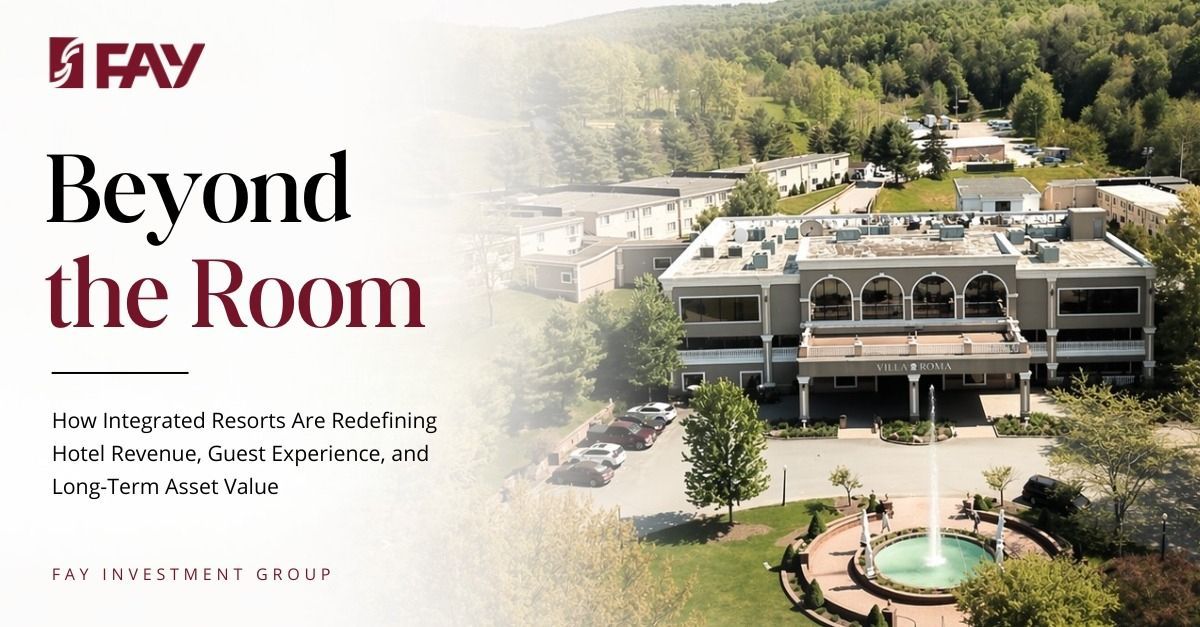
How the structural shift from room-led to experience-led models is redefining how hospitality assets are operated, valued, and invested and what it means for the next generation of resort development.
Introduction
Hotel investment has traditionally been structured around a single driver: the room. Occupancy and Average Daily Rate (ADR) defined performance, while food and beverage, leisure, and programming played supporting roles. Capital followed this logic. So did brand standards and reporting frameworks.
Guest expectations have evolved considerably, and the integrated resort segment has been at the forefront of that change. Today’s upper-income leisure traveler selects a destination on the basis of what it offers across the full breadth of a stay. Activities, programming, wellness experiences, culinary discovery, and the overall sense of a place that rewards the decision to be there have become primary factors in destination selection. When a family or couple considers a long weekend away, the questions shaping their choice center on what the property offers them to do, experience, and take home.
This evolution in guest motivation carries significant implications for how integrated resort assets should be developed, operated, and invested. It reframes where capital should be directed, how performance should be measured, what a hospitality brand needs to represent, and where the most durable sources of long-term value creation reside.
This article examines the structural shift from room-led to experience-led integrated resort operations, the commercial and financial case for that transition, the emerging role of wellness and culinary programming as primary demand and revenue drivers, how technology and data are reshaping the guest relationship, and what the totality of this shift means for investors seeking to identify and underwrite assets built for where leisure travel is heading.
The Room-Led Model and Its Limits
The traditional hotel development approach concentrated capital and strategy on the guest room above all else. The assumption was that room quality drove rate, rate drove revenue, and revenue drove returns. Renovation cycles were organized around room refurbishment. Brand standards were written around physical specifications. Performance was measured in RevPAR, which captured room revenue and ignored everything else.
This produced a predictable pattern. Hotels competed by upgrading rooms. Budgets went toward linens, tile, fixtures, and bath products. Lobbies got redesigned. Restaurants were an afterthought. Activities, if they existed at all, were offered without coherence or commercial intent.
The problem with this approach is visible in how guests actually behave. A well-appointed room at a resort satisfies a baseline expectation. Once that baseline is met, it does not produce loyalty or advocacy. It simply avoids a complaint. A guest who spends two nights in a comfortable room with no particular reason to be in that specific place has no particular reason to return or to tell anyone about the experience.
The revenue consequences are also significant. A room-centric operation concentrates the property’s income in a single category that is directly exposed to rate pressure, OTA channel costs, and occupancy volatility. Every unfilled room represents permanent lost revenue with no reduction in fixed costs. There is no offset and no alternative.
In established leisure markets like Sullivan County in the Catskills, where visitor spending has grown substantially since 2019 and the regional leisure economy has attracted meaningful new investment, this distinction matters. Properties that have invested in experiential programming, curated activities, and genuine wellness offerings are generating total guest revenue well above what their room rate alone would suggest.
The Experience-Led Model: A Framework for Understanding the Shift
The experience-led operating model does not abandon the fundamentals of hotel economics. Occupancy and rate still matter. Revenue management is still a discipline. The physical asset still needs to meet a standard appropriate to its market positioning. What changes is the strategic hierarchy: experience is the primary driver of value creation, and the room is one component of a broader offering rather than the product itself.
The operational and financial differences between the two models are material, and they affect how assets are managed, how performance is measured, and how value is created and captured.
| Dimension | Room-Led Model | Experience-Led Integrated Resort |
|---|---|---|
| Primary Value Driver | Room quality and brand | Programming, activities, overall experience |
| Revenue Mix | Rooms-led (70–80%) | Diversified across rooms, F&B, wellness, activities |
| Performance Metrics | RevPAR, ADR, occupancy | TRevPAR, ancillary spend per guest, lifetime value |
| Capital Allocation | Focus on room upgrades | Spread across programming, wellness, F&B, amenities |
| Guest Behavior | Transactional, lower repeat | Experience-led, higher spend and repeat |
| Differentiation | Rate and brand | Depth and quality of experience |
| Brand Positioning | Star rating and flag | Destination identity and recall |
| Revenue Management | Rate and channel focus | Package pricing and total guest spend |
Source: FAY Investment Group analysis.
The distinction in measurement is important. RevPAR (Revenue per Available Room) reflects room revenue efficiency, but it does not capture what a guest spends beyond the room.
TRevPAR (Total Revenue per Available Room) provides a more complete view. It reflects the full value of a guest across dining, wellness, and activities.
In practice, a property with a lower room rate but stronger programming can generate higher total revenue per guest than a higher-rate, room-led competitor. That difference flows directly into income, asset value, and returns on capital.
Programming, Entertainment, Activities, and Wellness as Core Revenue Drivers
Programming, entertainment, activities, and wellness are key to how modern leisure demand is being shaped across resort assets. They are central to how guests evaluate and choose a stay.
For instance, wellness has moved into a core role in how guests make decisions. For a growing segment of guests, especially at the upper end of the market, the decision is shaped by what a property allows them to experience over a few days and how they unwind, reset, and return feeling different. The expectation spans physical, mental, and emotional well-being and mindfulness, and it increasingly guides destination choice.
For a growing segment of guests, especially at the upper end of the market, the decision is shaped by what a property allows them to experience over a few days and how they unwind, reset, and return feeling different. The expectation spans physical, mental, and emotional well-being, and it increasingly guides destination choice.
In this context, wellness becomes part of the core product. Facilities such as spas and fitness centers remain important, but what sets a property apart is how these elements come together through structured programming.
A well-designed wellness offering goes beyond access. It creates a clear experience that guests can understand, engage with, and plan their stay around. That shift is reflected in both pricing and depth of engagement.
The Mind–Body–Soul Framework
Wellness programming works best when it is structured with clarity. A practical approach is to organize it across three interconnected dimensions:
| Pillar | Focus Area | What It Addresses |
|---|---|---|
| Mind | Cognitive and emotional wellbeing | Focus, stress management, mental clarity |
| Body | Physical health and recovery | Movement, energy, nutrition, and restoration |
| Soul | Experiential and relational wellbeing | Emotional connection, presence, shared experience |
This structure brings coherence to the stay. It allows programming to feel connected rather than a set of separate activities.
Mind sessions typically focus on attention, stress, and mental clarity, areas that resonate with guests balancing demanding routines. Body programming integrates movement, recovery, and nutrition, often linking directly with food and beverage experiences. Soul programming shapes the emotional tone of the stay through shared and immersive moments that guests tend to remember and talk about.
The Packaged Retreat Model at The Villa Roma Resort
Structured programming is most effective when delivered as a complete experience rather than as individual sessions.
At The Villa Roma Resort, the “Health and Horizon Weekend” is currently being delivered as a one-day curated experience. With growing demand, the intent is to expand this into a full three-day retreat with a clearly defined flow from arrival to departure. The longer format is designed to build continuity across the Mind, Body, and Soul framework, rather than treating sessions as isolated touchpoints.
This format is expected to influence both engagement and revenue:
- Package pricing reflects the full experience rather than individual elements
- Guest participation increases as the journey becomes more structured and immersive
- Shared moments strengthen recall and word-of-mouth
- Fixed programming windows to support consistency in delivery and operations
Elements such as an evening sound session or a closing gratitude circle are intended as anchor moments within the expanded retreat structure. These become the reference points guests associate with the stay and often carry forward in how they describe the experience.
From an operational standpoint, moving toward a defined multi-day format also enables tighter coordination across practitioners, culinary teams, and space utilization while allowing the experience to scale more consistently across guest cohorts.
Programming Structure and Revenue Design
| Pillar | Experience Type | Guest Outcome | Commercial Role |
|---|---|---|---|
| Mind | Mindfulness and cognitive sessions | Improved focus, stress management tools | Core experience; included in mid and premium tiers |
| Body | Movement, yoga, recovery sessions | Energy, balance, physical reset | Foundational layer; included across tiers |
| Body + Mind | Nutrition and culinary workshops | Practical understanding of food and health | Drives F&B engagement; bundled or upgraded |
| Soul | Sound healing, guided sessions | Emotional reset and restoration | High-impact; supports satisfaction and recall |
| Soul (Premium) | Ceremonial experiences | Immersion and connection | Limited capacity; premium pricing |
| Mind + Soul | Reflection and closing sessions | Completion and take-home value | Included; supports repeat intent |
Source: FAY Investment Group, based on the ‘Health and Horizon Weekend model’ at The Villa Roma Resort.
Commercial Approach in an Experience-Led Model
An experience-led resort is sold on the stay, not the room.
Marketing needs to show how time is spent on the property. Programming, wellness, and the flow of the stay matter more than room features. In short-stay leisure destinations such as the Catskills, guests are choosing how to spend a few days, not comparing room specifications.
Revenue management follows the same approach. The unit is the package, not the room night. Accommodation, programming, and dining are priced together. This increases participation, improves control over capacity, and lifts total spend per guest. Average Order Value per stay is as important as Average Daily Rate (ADR).
Loyalty programs depend on how well the property uses what it knows about its guests. Past participation, preferences, and booking patterns should shape the next stay. A returning guest should see continuity, not a generic offer.
Progression matters. Priority access, limited-capacity experiences, and tiered participation create a reason to return and engage more deeply over time.
The objective is simple: increase engagement across the stay and capture a larger share of total guest spend.
What This Means for Real Estate Investors
The shift toward experience-led integrated resort operations has direct implications for how hospitality assets should be underwritten, how capital should be allocated, and how long-term value should be assessed.
The first implication is a reexamination of capital allocation. Most hospitality underwriting models direct the majority of capital improvement budgets toward guest room renovation, on the assumption that room quality drives rate and rate drives value. In an integrated resort operating on an experience-led model, the allocation of capital across the property is a more complex question. Investment in programming infrastructure, wellness facilities, culinary capability, and experiential amenities can generate revenue returns that are equal to or greater than the same capital deployed into room upgrades. Investors who underwrite using only room-centric assumptions will miss both the full revenue potential and the true capital requirement of operating these assets well.
The second implication is the appropriate basis for valuation. Properties with diversified revenue models and well-developed experiential programming should be valued on total revenue performance rather than room revenue alone. The income generated through F&B, wellness, activities, and programming is real income. In many cases it is more defensible than room revenue because it is tied to the property’s specific offering rather than to the broader room inventory market. Applying a RevPAR-based valuation framework to a well-run integrated resort systematically understates its income and its value.
The third implication is the recognition of programming quality as a component of asset value. Brand affiliation is widely understood as a driver of hospitality asset valuation. The quality and distinctiveness of an integrated resort’s experiential programming serve a similar function. A property with a recognized wellness program, a curated calendar of activities, and genuine practitioner relationships has a competitive position that supports pricing power and guest retention in ways that are difficult for competitors to replicate quickly. Investors who can identify and invest in programming quality, not just physical infrastructure, are in a better position to find and develop assets with durable performance characteristics.
Finally, the experience-led model produces a more resilient revenue profile. A property with diversified income streams, strong direct booking driven by programming reputation, and a guest relationship built on experience rather than price is less exposed to the rate volatility and OTA channel pressure that characterizes room-centric operations. That resilience has investment value that should be reflected in how these assets are underwritten.
Evaluating Integrated Resort Assets: An Investment Lens
| Area | Key Consideration |
|---|---|
| Revenue Quality | Extent of diversification beyond rooms; strength of ancillary income streams |
| Total Guest Value | Ability to drive spend across programming, F&B, and wellness |
| Experience Depth | Quality, structure, and consistency of programming |
| Demand Alignment | Fit between asset offering and target guest profile |
| Pricing Power | Ability to sustain premium pricing through differentiated experience |
| Capital Efficiency | Returns generated from investment in programming and amenities, not just rooms |
| Resilience | Balance of revenue streams and reliance on direct vs. channel-driven demand |
Source: FAY Investment Group. Framework reflects performance evaluation standards appropriate to experience-led integrated resort assets.
Conclusion
Experience is where value is shifting in the US leisure market, most visibly in drive-to leisure destinations within a few hours of major cities. Sullivan County reflects this pattern. The guest is typically a time-constrained urban professional with meaningful discretionary spend, taking short, intentional breaks where the quality of time spent matters more than the room itself.
Supply at this level remains limited. Properties that combine programming, wellness, and a coherent operating model are seeing higher total spend per stay, stronger repeat behaviour, and less sensitivity to pricing.
This gap defines the opportunity. Many established resort assets in strong locations are still assessed on room-led benchmarks, even though their potential sits elsewhere. With the right repositioning, these assets can support a more diversified revenue mix and a more durable guest relationship.
Outcomes depend on a few fundamentals. The asset must be able to support programming in a meaningful way. The demand base must be consistent enough to sustain it. The entry point must reflect what the asset can deliver once repositioned. When these are in place, the result is a more balanced income profile and a more resilient asset.
At FAY Investment Group, our approach to hospitality investing starts from the conviction that the assets worth owning are the ones built around what guests actually want from a stay. In the integrated resort segment, that means investing in experience and operating with the discipline to deliver it consistently.
Fay Investment Group | Investment Insights 2026